The University of Puget Sound recently hosted the Washington State Special Olympics Spring Games, bringing soccer, swimming, and track athletes to campus alongside the vital FUNfitness health screening program. Backed by thousands of volunteers, including Puget Sound students, this marks the second year the university has hosted the games — a partnership that Liz Corwin, FUNfitness clinical director and Puget Sound assistant professor, said has transformed the experience for both Puget Sound students.
“This year, we have a lot of students who signed up to volunteer. That's really exciting,” Corwin said. “A lot of what I get to do is supervise, which is me watching my students hit it out of the park.”
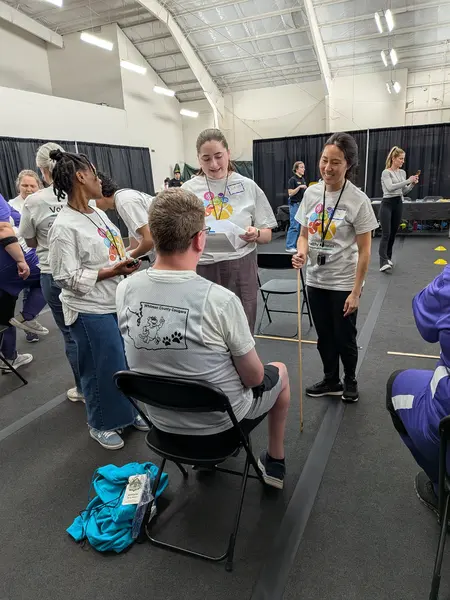
Whether they are returning alumni or first-year students putting their skills to the test for the first time, these volunteers embody the mission of experiential learning at Puget Sound. This experience is centered on the FUNfitness health screenings, which are held in the tennis pavilion of Memorial Fieldhouse, where athletes come straight from their competitions — many still wearing their medals. Corwin volunteered with the Special Olympics for years before taking on the director role. She acknowledges that access to healthcare is limited for many people and that medical visits can often be intimidating. FUNfitness aims to eliminate these barriers.
“The athletes know that at FUNfitness, they will be listened to and they will be respected,” Corwin said.
Physical therapy graduate Lisa Cullen DPT’27 volunteered again, not for a grade since she had already fulfilled the program’s service requirement, but because she found value in the experience.
“I just came for the fun of it because it was so enjoyable the last time I participated,” Cullen said. “And it's fun to meet the athletes, and we get to practice our skills. We get to be involved with the community, so it's just a nice way to give back.”
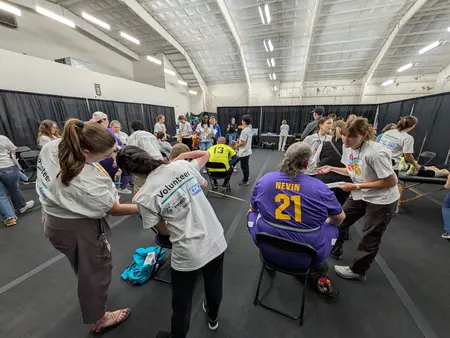
Cullen is one of nearly two dozen physical therapy and occupational therapy students from Puget Sound who volunteered. The students work with the athletes to assess their flexibility, balance, endurance, and strength. For many athletes, it’s an opportunity to see a healthcare professional who listens to their needs. For students like Cullen, it provides a valuable lesson in respect, as well as clinical skills.
To better serve the athletes and volunteers, Corwin pairs first-year students with upper-level mentors. This allows her to observe nervous newcomers become confident clinicians within just an hour.
“Mentorship is really built into our program,” Corwin said. “We have returning graduates this year and pair students in groups accordingly. What usually ends up happening is the first-years do most of [the testing] and the upperclassmen are there supporting them, which is great to see.”
First-time volunteer and OT student Claire Schomogyi OTD’28 said the opportunity to work with the athletes and the event’s location prompted her to participate.
“I saw that it was on campus, and I thought, this is perfect. I want to gain exposure and practice what I've been learning,” she said.
For students like Cullen, the experience provides crucial clinical exposure to a broad range of physical, psychological, developmental, and intellectual conditions. Cullen notes that this interaction is vital in challenging perspectives on athletic ability.
“I definitely think meeting all the athletes … they kind of push back on what we think an athlete is,” Cullen said. “They've just shown all of us that they can do everything that [anyone else] can do as well.”
Despite having already graduated, Linsy Owen DPT’26 decided to volunteer for the first time. She hopes to work with individuals with intellectual and developmental disabilities after earning her physical therapy license and pursuing a career in neurology or geriatrics.
“Community engagement and addressing the healthcare needs of this population are extremely important,” Owen said.
To learn more about the university’s PT and OT programs, visit the university’s Graduate Programs page.
FUTURE GRAD STUDENTS
Stories to be featured on the Future Graduate Students audience page
CURRENT GRAD STUDENTS
Stories to be featured on the Current Graduate Students audience page
COMMUNITY
Stories to be featured on the Community audience page