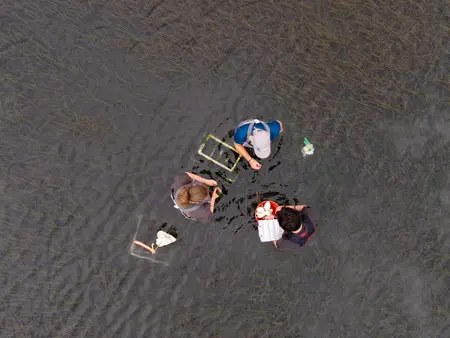
In the early morning hours of a warm summer day, the tide in Puget Sound recedes, revealing glistening tide pools filled with an array of sea creatures. There, University of Puget Sound students Vincent Wills ’27 and Bea Moldow ’28 find themselves knee-deep in mud, placing PVC quadrats through the eelgrass beds and counting stalks by hand. They measure each stalk, record its length, and note the density of the plants around them, working methodically before the tide returns to reclaim the shore. It feels a world away from the lecture halls of Tacoma.
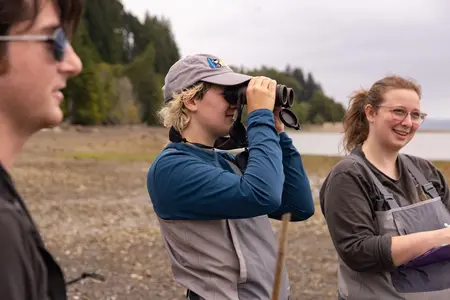
It’s not the kind of work either of them imagined when they arrived at Puget Sound. But for the duo, a summer internship with the Washington State Department of Natural Resources has become one of the more formative experiences of their college careers — reshaping how they think about science, government work, and what comes after graduation.
Both students are interning with DNR’s aquatics division, based in Olympia, with funding from Puget Sound’s Student Fellowship Initiative (SFI) program. Their schedules alternate between field weeks, when they travel to the shores of Puget Sound for sample retrievals, and lab weeks, when they process the data and samples they’ve collected.
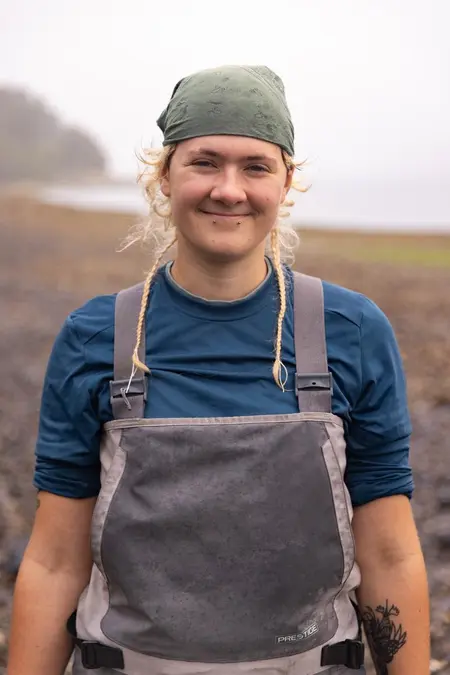
“I really love that I get to be outside and experience the Puget Sound,” Moldow said. “It's really nice to be outside on those sunny days through the water and counting eelgrass for a job.”
The internship has the students monitoring eelgrass, a marine plant that plays a major role in coastal ecosystems by stabilizing sediment, storing carbon, and providing habitat for marine life. At sites such as Willapa Bay, Grays Harbor, and locations near Nisqually, the students use quadrats — small PVC-pipe squares — to measure eelgrass density and species composition. They also monitor sensor-equipped cages that track water temperature and pH, and compare healthy eelgrass beds to nearby areas without the plant.
In the laboratory, the focus shifts to analyzing sediment. This involves drying, burning, and weighing soil samples to determine grain size and carbon content. Additionally, researchers examine spat sticks — bamboo stakes strung with oyster shells — under a microscope to look for signs of oyster and clam larvae.
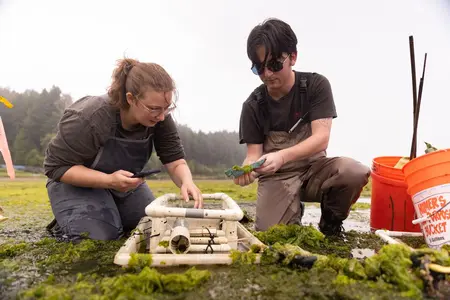
As part of their internship, both students are completing independent research projects using the team’s data, structured much like capstone projects.
“It’s a lot of applying the stuff that we’re learning in the classroom and in the field and creating a question about eelgrass,” Wills said.
Moldow arrived at Puget Sound intending to study environmental science before deciding to double major in Spanish, Culture, and Literature, and the Science, Technology, Health, and Society program. They were surprised by how much they’ve enjoyed the research aspect of their internship.
“I loved the opportunity to do fieldwork. You don’t really get that much in my major otherwise,” Moldow said.
They learned about the DNR opportunity through their academic advisor and gained support from the SFI program.
“The SFI program is so important because it provides interns from many different spaces to come together and reflect on their experience in a community of their peers,” Moldow said. “It provides problem-solving support when encountering more real-world styles of work, and the knowledge that you have an adult on campus who is willing to help advocate for you within your internship workplace.”
For Wills, the program played a crucial role in broadening his plans for life after graduation. By exploring different internship opportunities through SFI, many of which were outside his initial interests, he was able to stay flexible and rethink his future career path. As a natural science major with a minor in biology, Wills applied to numerous internships in conservation biology and ecology before securing a position with the DNR. He acknowledged that he likely wouldn't have discovered this specific role without the support of SFI.
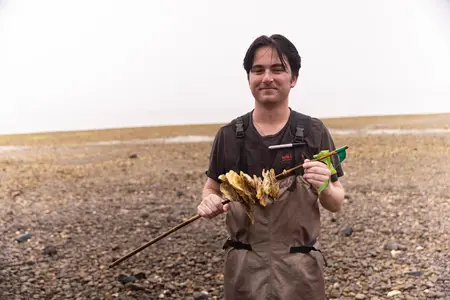
“This internship opportunity has allowed me to better determine what it is I want to do in my future, so I’m grateful for the chance to do such interesting work in conservation biology,” he said.
For both students, the internship has revealed a side of agency work they hadn’t expected.
Moldow was surprised to learn how many different kinds of jobs exist within DNR, including a volunteer coordinator on their team who is scientifically trained but spends most of their time on outreach and communication rather than fieldwork.
“I thought DNR was going to be more about working in the field,” Moldow said. “Actually, this job included a lot more lab work and other tasks, and with other people within different departments at the DNR. I am definitely learning a lot more about the intricacies of these jobs. I think that is so important to the experiential learning aspect. There’s a lot you don't see from outside.”
Wills said the internship challenged his assumptions about what government science careers look like.
“You don’t think the government has some sort of science division, but they do, and it’s not all on the computer and behind a desk either,” he said. “It’s very specific research, but it’s still lots of fun and very interesting.”
Both students said the internship has sharpened, rather than settled, their career plans.
Moldow said the experience has made them seriously consider a future with an agency like DNR. They are also interested in international sustainable farming work and are preparing to study abroad in Mérida, Mexico.
“This is definitely changing my view on, like, ‘oh, I could work for the DNR,’” Moldow said. “I could do this for a living. I really am enjoying it.”
For Wills, who graduates this year, the internship clarified what he doesn’t want as much as what he does.
“I think it’s solidified that I don’t want to be behind a desk most of the day,” he said. “I think it increased my interest in more researchy things.”
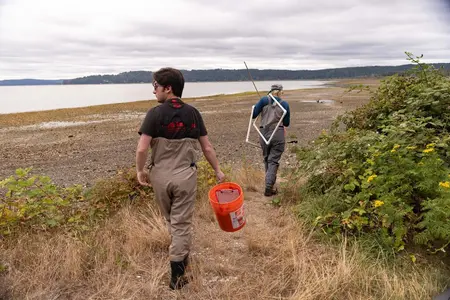
He said the daily rhythm of fieldwork has stuck with him.
“I get to go out into the field, and I get to see a crab and a minimum of two bald eagles every day," he said. “It makes the experience a lot cooler and much more memorable.”
Both students encouraged classmates to pursue similar opportunities, even if they don’t feel fully prepared.
“I definitely felt underqualified,” Moldow said. “But after doing the job, I definitely think I was qualified enough. So I would say trust in yourself and in your abilities.”
Wills had similar advice for students who haven't settled on a career path.
“Don’t go into it saying, ‘This is the only thing I need or want to do,’” he said. “You have a lot of time to get there and get interesting experiences and make great connections.”