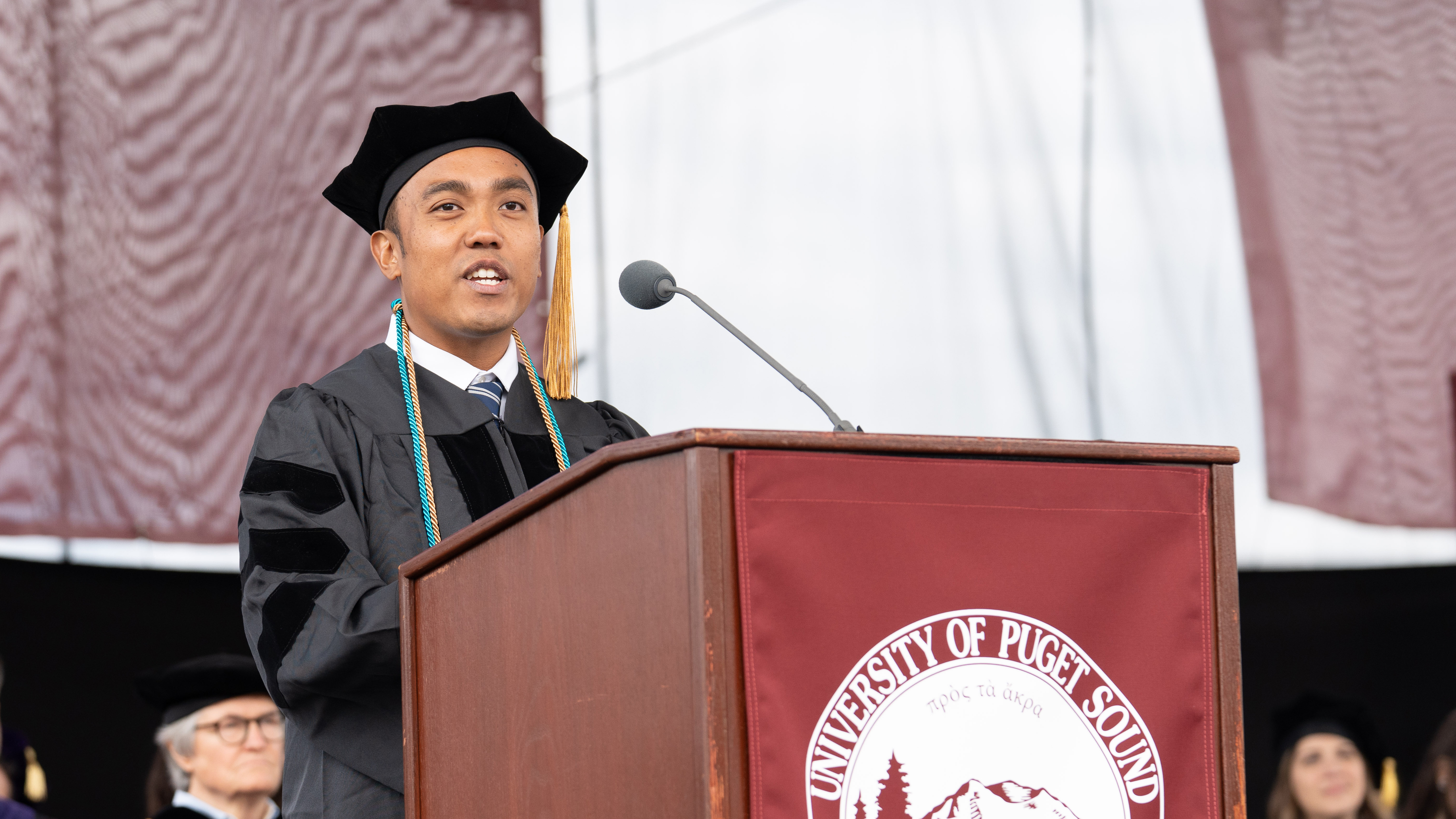
I'll begin with a challenge: Could you sum up your college experience in one word? It seems impossible, right? When I was asked this question recently, I agonized over the perfect one; Profound? Indelible? Friendship? Trees? What has been the basic throughline of my college experience? When I thought about it some more, I realized that the word I was looking for was right under my nose as I searched; If I were to sum up my college experience in one word, it would be “confusion.”
Before I transferred to Puget Sound, I was a student at a drama conservatory inside a Division I institution of 40,000 students. To my knowledge, I would spend the next four years in the blissful constancy of pure theatrics. For some time, this was true–the training and mentorship I received at this program fundamentally transformed who I am–But when, in my second year, I began to reevaluate, the image I had conjured of my undergraduate experience began to dissolve. I felt lost, embarrassed even, at my newfound confusion.
When I transferred to the University of Puget Sound in the Fall of 2024, confusion had become a familiar friend and would remain so. Not only was I transferring to a new place, but from a conservatory to a liberal arts school, an entirely new educational structure. Would I be able to keep up with the intensity of scholarly work I knew Puget Sound would bring? Would I find my place?
When I was transferring, I posted a quote on my wall that I find myself thinking of a lot these days as I prepare for the next major transition in my life. It’s from the play Translations by the Irish playwright Brian Friel. In the play, the character Hugh, a school teacher, is talking to his son, Owen, a young man questioning his purpose and social responsibility, when Hugh tells Owen “confusion is not an ignoble condition.”
Confusion is not an ignoble condition? It’s a curious sentiment, right? A confusing one perhaps. As a young person questioning my own purpose and place who hated the feeling of confusion, I wasn’t sure how to interpret the quote–Am I to believe that confusion is noble? Or simply be neutral about the concept? Either way, a world in which confusion wasn’t an experience I found deeply uncomfortable seemed far-fetched.
Join me in another challenge; could you articulate what confusion actually is? Is it a feeling, a state of being? Lately, it feels as if confusion is indiscernible from fear: as our public and private worlds ache from the pains of a humanity in flux, a clear idea of the future can seem like a thing of the past. When I look at that quote now, I desperately want it to mean its most simplified reading; that confusion is an expressly noble condition–That, maybe, confusion is a first step, the very root from which learning blossoms, to insist upon a solution and acknowledge a better way. Perhaps, confusion is a declaration of the nobliest of conditions; a declaration of hope.
When I think of confusion this way, I can’t help but think of the very structures of education present here at The University of Puget Sound. Puget Sound’s mission statement does not include the words answer or clarity, rather, it emphasizes curiosity. It states that the University aims to liberate “each student's inherent potential to assist in the unfolding of creative and useful lives.” Surely, this does not happen in the absence of confusion. Surely, this does not happen in the absence of hope; hope in the wisdom of those before us, in the possibility for progress, and our own capacities to aid it. With every essay, reading, yes, even bad grade, we invest in the promise of a transformed society, one rooted in justice, peace, and global stewardship. Education is, in and of itself, a declaration of hope.
For the past few years, you have invested in this promise in impressive and myriad ways. You have mastered mediums, proven theories, published papers, built communities, and sanctified the prestige of the Puget Sound student. There have certainly been moments when you didn’t feel confused. These moments define us, as well. Congratulations on these moments.
I would like to say that I speak to you now on the other side of the journey to embrace confusion, but this is not the truth. Truthfully, I, as I am sure many of us do, anxiously anticipate what confusions the next chapter of my life will bring. I know there will be challenges which will test my limits and optimism. But then I look around me, at this university I found myself at in a leap of faith, at the class of 2026 who took similar leaps and will again, at the families, friends, faculty and staff here today who have dedicated countless hours, if not their lives, to the beacon of hope in our world which is education, and I see suddenly that every good thing in my life, as, I believe, every instance of progress in our world, began in a moment of confusion.
Perhaps our responsibility going forward, and the responsibility of a Puget Sound alum, is not professional excellence or scholarly prowess — although I am sure the class of 2026 will certainly excel in these fields. Perhaps it is to engage with confusion, as our time at this university has taught us to do, no matter how frightening.
I’ll leave you one more challenge: to remain confused, and, in it, awestruck, curious, and forever learning. I challenge you to never recede from this noble pursuit, a pursuit which is ultimately that of hope.
Congratulations on this extraordinary achievement, there is no place I would have rather bore confusion for this time.