Faculty, Students

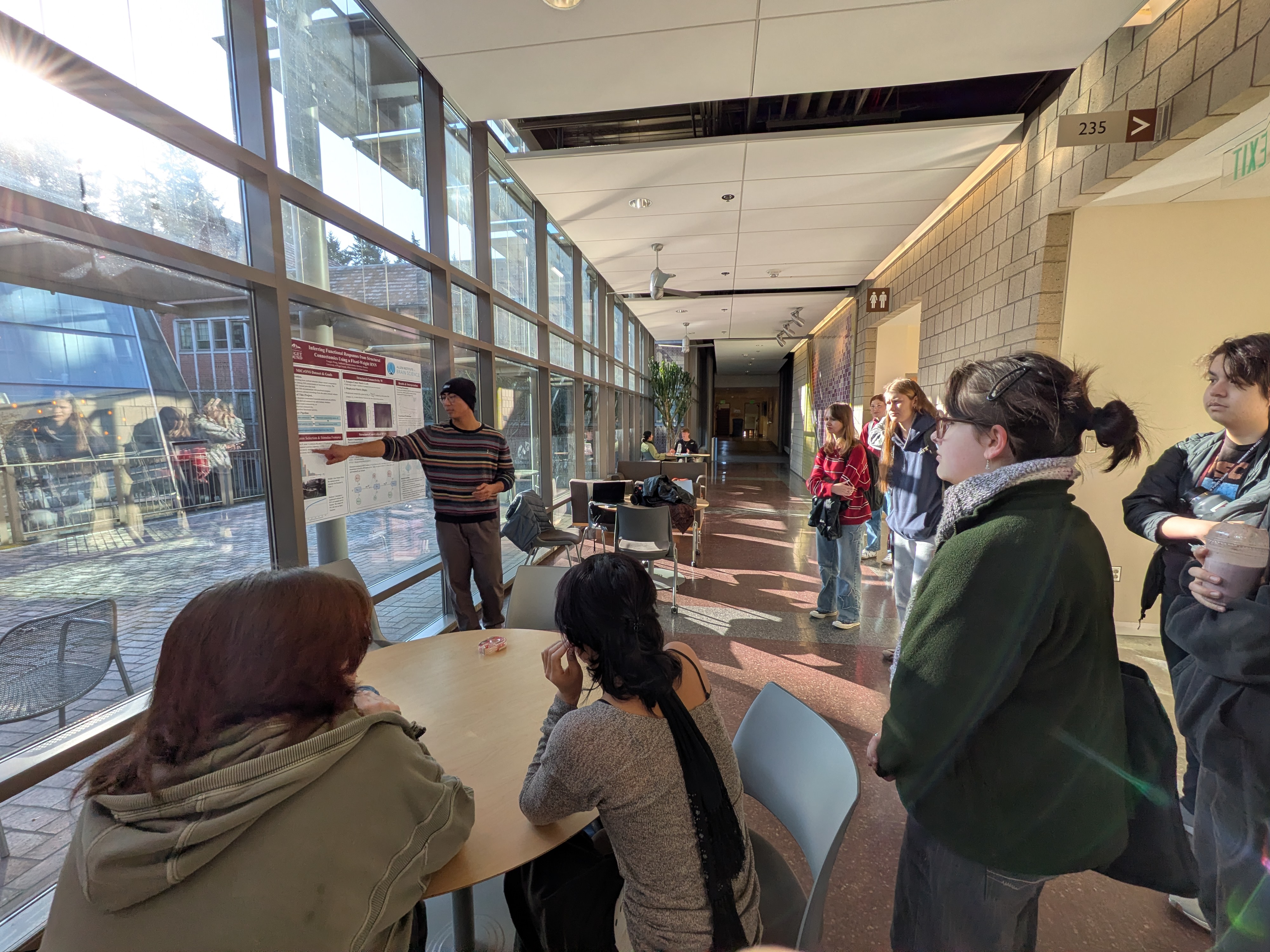
Here at the University of Puget Sound, students take their fresh insights and ideas far beyond the classroom, turning passion projects into reality through the Office of Experiential Learning’s Summer Research program. Working closely with a faculty advisor, they spend the summer exploring questions in their field and developing their own research projects. Along the way, they get the time and resources to deepen their expertise, whether that’s studio art, chemistry, or whatever they’re most passionate about. Those accepted into the program craft a project proposal that, if approved, results in a 10-week, full-time research position, along with a stipend from the university and its donors to cover living expenses and the possibility of additional funding for research expenses or travel. Curious about what summer research looks like across a variety of disciplines, we sat down with four summer research students to hear about all that they’ve been up to.

Sarah Burer ’27

Sarah Burer, a studio art major, is participating in research this summer alongside Assistant Professor of Art and Art History Rebecca Padilla. Burer is one of three researchers working alongside Padilla, each completing sculpture-based pieces. Burer’s project, titled Exploration of Light Through Sculpture, involves the creation of two large structures made from steel rods that will become hanging light sculptures, covered in various natural materials Burer has been collecting. 

“I’m growing grass, and once it’s grown, I’m going to take the grass and make that into paper. Then I’m going to take the roots and dry them out, and that will be its own textile,” she says. “On the trays I grew them in, I put designs on the bottom, so the sheet of root takes to the design. And I’m also growing two large scobies.” 

Working in a studio with other art students inspired Burer’s own work. She notes, “I’ve really enjoyed working with other people, because we’ll just take a walk midday and try to find things to make things out of. I think that’s one of my favorite things about art: you can make it out of anything.” 

In recent years, the number of humanities researchers and science researchers has equaled out, creating an increased emphasis on art research. When asked about how the experience has been, Burer said. “It's really been beneficial to me. I enjoy making things, and it’s beautiful to have an opportunity where I can get paid to do that and focus on that. And I do think this would be a good opportunity for people if there’s something they’ve always wanted to try or do but haven’t necessarily had the means to.”

Morgan Cottrill ’27

This summer, Morgan Cottrill’s research project, The Co-Development of Colonial Empire and Natural History Museums, examines the origins and usage of specimen collections, ranging from animal remains to cultural artifacts, and the public ambiguity surrounding their place in modern museums. Cottrill says that ambiguity “exists as another barricade to decolonization within those institutions.” While she is looking at this specimen collecting through a historical lens, specifically the early 1800s to the mid-1900s, Cottrill also plans to compare it to today’s museum landscape. 

“I’m looking to examine how the social values of science have shifted to move away from the colonial practices of the natural history museums,” Cottrill says. 

She started with a broad literature review, researching what specimen collecting looked like along with relevant laws, policies, and academic research. Since then, she has narrowed her focus to London's Natural History Museum, due to its colonial relationship with India. Going in, Cottrill had a very different idea of what her project would look like, but after not being able to find enough existing research on her proposed idea, she had to shift gears. 

“I thought there was going to be this slow development of governments and science institutes recognizing that there are issues within our operations, and I spent a lot of time searching through archives to find when that shift was, but there was nothing there,” she says. 

Asking around and thinking further about what might have sparked a change in how museums collect specimens, Cottrill landed on a new approach. “I was talking to one of my housemates, and she was like, ‘What about the camera?’ And that made me think, maybe it’s a bunch of different things: the camera, the microscope, and other changes in the field of science, as well as what was happening in the political landscape at the time,” she says.

Changing direction is a normal part of research, and the experience can help students become more comfortable navigating uncertainty. Asked whether she’d recommend summer research to other students, Cottrill says, “You should do it, especially if you’re interested in doing research after college or applying to grad school. If I hadn’t had this experience, I’d be much more nervous about what I’m doing next.”

Mirella Bennett ’27

Mirella Bennett spent her summer working full-time in Associate Professor Bryan Thines’ biology lab, investigating FBIP, an F-box interacting protein, and how it affects plant growth. The Thines Lab is trying to understand what this protein does in relation to the Anaphase Promoting Complex (APC/C), a hub of protein interactions that’s critical for plant growth. Bennett is one of several students working on this ongoing research project.

“This research is very preliminary and very exciting,” Bennett says. “We’re all investigating different parts of the system. Mikhail and I are investigating two proteins that both work with the APC/C. And Winston is essentially looking at the activator complexes that also work with the APC/C. So, it’s kind of like we’re all getting different pieces of the puzzle, to get a bigger picture of plant growth, which is really cool.” 

Bennett has found that the protein she’s investigating may have significant implications for future climate change research. 

“I have reason to believe that my protein influences stomatal growth patterns. Essentially, stomata are what allow the plant to breathe, these little holes that sequester carbon,” Bennett says. “So, it’s a really big area of research, because with climate change, obviously there’s too much carbon in the atmosphere. And if we could get plants to sequester more of that, it would have a significant impact on our future.” 

Bennett hopes to continue her research this academic year. Following graduation, she plans to work as a biology lab technician, a goal her summer research experience has confirmed for her. 

“Now I feel more solid that this is the path I want to continue in: bio research. Hopefully with plants, because I like plants, but we’ll see where life takes me.”

Jamie Eckmann ’27

Jamie Eckmann, working with Associate Professor of English Laura Krughoff, is pursuing a summer research project in Gender & Queer Studies and English. Titled The “Transgender Terrorist” and the Creation of Proof: The Rhetorical Strategies of Modern Anti-Transgender Politics and Policymaking, the project examines the rise in vitriol toward trans communities. Describing his research, Eckmann says, “Predominantly, what I’m trying to do is track how the political right uses rhetorical strategies to construct a version of transgender identity that is monstrous, and then use that identity to justify more violent acts.”

Eckmann has focused on the power of language, examining how written U.S. legislation fuels anti-trans laws and violence. Researching violence toward a community he loves and belongs to is extremely difficult. He notes, “I think the only challenge is that it sucks. You’re sort of steeped in all of this nastiness for hours at a time.” Despite this, Eckmann has made significant progress, writing a literary analysis paper, connecting it to current events, and setting their sights on a more active role in the future.

“More than anything, it’s shown me that I want to go more into activism, whatever that looks like, whether that’s a public policy degree, a master’s, or law school — just starting to be more engaged with activism and what people are doing currently to combat this,” Eckmann said. “Because as interesting as researching it is, it doesn’t really change that much. So being more involved in the process of change is something I want to do moving forward.”

Summer research at the University of Puget Sound is open to all interests and passions. It’s a unique opportunity that allows undergraduates to complete full-time research with a faculty advisor and present their findings to the wider campus community. Though demanding, the program allows students to deepen their expertise, clarify their future goals, and gain new perspectives on themselves. To learn more, visit Puget Sound’s Summer Research webpage.