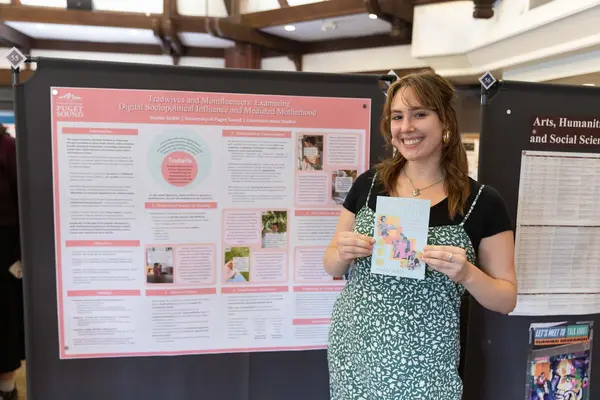
Sophie Goble ’27, a double major in communication studies and sociology and anthropology (SOAN), spent her summer examining the growing digital phenomenon of “tradwives.” Her research analyzes how U.S.-based “momfluencers” and traditional wives use social media to communicate political and ideological beliefs, often without stating them directly.
Goble’s project highlights a key distinction in the digital world. All online tradwives act as momfluencers by sharing domestic life, but not all momfluencers call themselves tradwives. Even parenting content that seems neutral — from homesteading to natural family planning — can carry significant sociopolitical meaning.
Her interest grew from a mix of personal experience and digital culture. As a teenager, Goble watched family YouTube channels as a form of entertainment. At the same time, she also grew up around public discussions about family life, in part because her mother runs a foster care nonprofit and speaks publicly about parenthood. Being surrounded by diverse conversations about parenting for an audience gave Goble a unique way to analyze how motherhood is presented online.
“Looking at moms on Instagram might seem like it’s a silly fad, but looking at these moms really does show the shifts in our society culturally, economically, and politically,” Goble said. “It’s super interesting to watch how a lot of these aesthetics are being adopted without this knowledge of the ideological underpinnings.”
Nick Brody, professor of communication studies and Goble's faculty advisor, said her project demonstrates the value of interdisciplinary training.
“Sophie's project is an exemplar of how students and budding researchers benefit from their exposure to multiple disciplinary approaches,” he said. “The project had roots in Sophie's qualitative methods training in Communication, as well as her knowledge of online and mediated communication practices that help us understand things like online celebrity and self-presentation on social media. At the same time, her coursework abroad and in the SOAN department let her extrapolate her analyses to broader cultural and societal debates.”
Through a thematic analysis of 225 Instagram posts from 15 content creators, Goble examined how momfluencers present domestic life in direct contrast to modern society. They frame contemporary life as fast, career-focused, consumer-driven, and artificial. In response, they offer an alternative that they claim is slow, family-centered, natural, and calm.
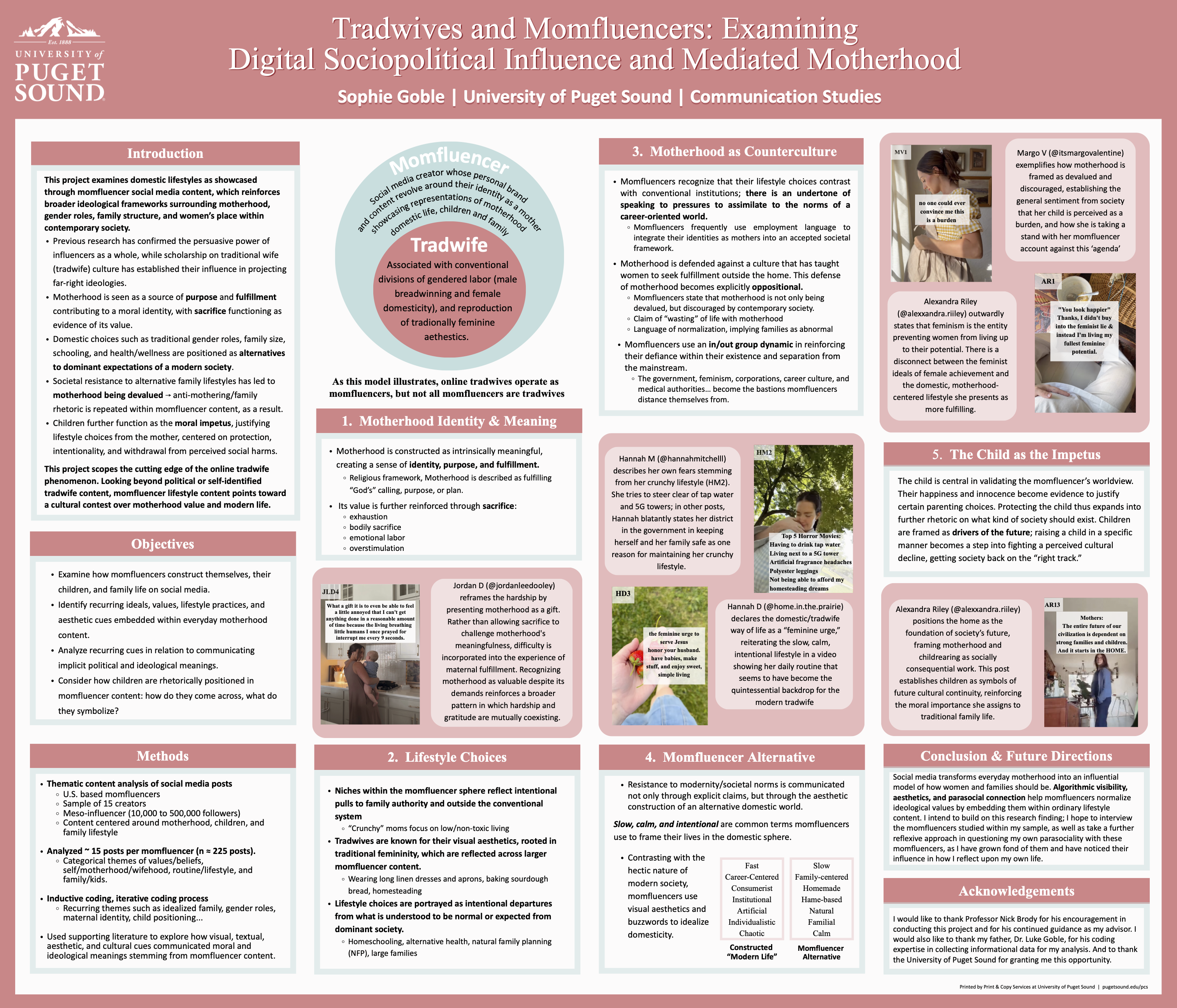
According to Goble’s research, these digital spaces, exhaustion, and physical sacrifice are not reasons to seek fulfillment outside the home. Instead, hardship becomes proof of motherhood’s value. Children are positioned as symbols of the future, and lifestyle choices like homeschooling or natural family planning are justified as ways to protect young people from perceived cultural decline.
“I frame it in my project as motherhood being an explicit counterculture almost,” Goble said. “That is how extreme the rhetoric they’re putting forward is. They talk about how they’re outcast and abnormal from society, and put themselves in this position as totally up against career culture.”
Goble’s work blends methods from both of her majors. Her qualitative coding framework came from her communication studies coursework. Her analytical approach was shaped by sociology and a study-abroad program in New Zealand focused on the anthropology of reproduction. Alongside her academic research poster, she produced a visual zine-style booklet compiling screenshots and text excerpts to document her findings. Brody explained that the research holds importance that extends beyond its specific topic.
“I think an outsider might see this sort of research as trivial, but when you consider how much time young people spend consuming this sort of content on social media, it is immediately evident how vital it is for us to critically examine the content that is shaping people's perceptions of gender, marriage, and parenthood,” he said. “Moreover, Sophie's rigorous analysis allowed her to draw unintuitive conclusions that would not have been visible to casual social media users.”
Brody explains that Goble’s findings reveal how creators present their lifestyle choices as a contemporary solution to a fast-paced, career-driven world, and that this perspective is likely to resonate with people who might not typically identify with tradiwives content or the values promoted by these creators.
The experience also gave Goble a more nuanced perspective. She said economic pressures make home-centered living appealing to many people, even as the aesthetic romanticizes traditional gender roles.
“I came into this project with a very one-sided view of what I thought tradwives were,” Goble said. “I’ve come out of it with a lot more empathy and understanding of their position. However, the tradwife aesthetic is being idealized so much that people are forgetting some of the scarier underpinnings, like wifely submission and strict gender roles in a marriage.”
As these digital trends continue to shape how younger generations view family and work, Goble said she hopes her research encourages people to look more critically at what they see on their screens.