At a moment when viewpoint diversity has emerged as a contentious and defining issue in higher education, University of Puget Sound Professor of History Ben Tromly has turned his attention to the origins and implications of this growing movement. For Tromly, examining this concept has become a critical endeavor to understand how political pressures are impacting the landscape of intellectual discourse on campuses nationwide.
In his paper, Viewpoint Diversity and Academic Freedom in Recent Higher Education Debates in the United States, Tromly argues that viewpoint diversity can be a concept that seems to support academic freedom but actually undermines it. What he discovered is that the seemingly innocent term has become a political weapon — one that threatens the very academic freedom it claims to defend.
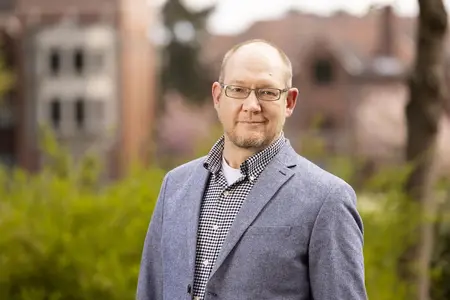
“Universities can’t function if external authorities are telling us what to do,” he said. “That defeats the whole purpose of it because academic freedom comes from our professional fields and the expertise that we’ve built up in those fields.”
Tromly is a historian who has previously researched higher education in the Soviet Union during the periods when Joseph Stalin and his successor, Nikita Khrushchev, were in power. Tromly widened his research interests to include academic freedom in the United States when he received the James Dolliver National Endowment for the Humanities Distinguished Teaching Professorship.
The James Dolliver National Endowment for the Humanities (NEH) Distinguished Teaching Professorship is a rotating, three-year faculty appointment funded by an NEH challenge grant. Named after former Washington State Supreme Court Justice James Dolliver, the role goes to a professor who builds a curriculum, leads a faculty seminar, and hosts visiting scholars around a specific theme. The rotating appointment allows a faculty member to focus on a curricular theme of their choice. Tromly chose to study universities and their current relationship with authoritarianism.
“I thought it would be interesting given that there’s essentially, I would say, an attack on academic freedom in the United States today,” Tromly said. “I wanted to look at the situation in this country through the lens of other countries that have dealt with challenges to academic freedom in the past.”
At first glance, viewpoint diversity seems reasonable — a call for campuses to accept a wide range of perspectives. Advocacy groups like Heterodox Academy, a nonprofit organization composed of academics, aim to address what they perceive as a shortage of viewpoint diversity, particularly political diversity, on college campuses. They define this diversity as the cultivation of a range of perspectives to ensure that scholarly inquiry remains open and dynamic.
But Tromly says the story is more complicated. The concept is commonly associated with promoting conservative voices in academia, often alongside claims that universities exhibit a leftist bias.
“As soon as you start saying that you need conservative and liberal positions, you're dictating what scholars say,” Tromly said. “Viewpoint diversity contradicts academic freedom, as it goes against the ability of scholars to determine truth without external political criteria. The consequences are serious.”
Tromly explains that the concept has been taken up by politicians and government officials who seek to prevent discussion of certain topics in the classroom, such as Black Studies and the study of gender and queer studies. Viewpoint diversity, in this context, is juxtaposed to diversity, equity and inclusion.
Tromly’s article takes a nuanced approach, examining not just why viewpoint diversity can be problematic but why it has gained such traction in recent years. He explains that academic freedom has three main tensions. First, academic freedom was initially established in the United States as a collective standard based on professional expertise. However, viewpoint diversity reframes this concept as an individual First Amendment right to free speech. In part, Tromly attributes this shift to conservative activist David Horowitz, who introduced the “Academic Bill of Rights” in the 2000s. This initiative used the notion of student speech rights to challenge the authority of faculty members.
Second, proponents of viewpoint diversity highlight internal debates within academic disciplines, claiming that conservative viewpoints are an oppressed minority in a predominantly liberal environment. By simplifying scholarship into a conventional left-right political spectrum, these critics legitimize external interventions aimed at balancing the academic landscape.
Finally, Tromly notes that the rise of administrative authority in modern universities has eroded faculty self-governance. Instead of protecting faculty autonomy, some risk-averse administrations frequently adopt the rhetoric of viewpoint diversity or yield to outside legislative pressure to manage public relations and avoid conflict.
“The paradox is that professors tend to take academic freedom for granted and not really understand it,” Tromly said. “I don’t think I understood what academic freedom was 20 years ago, even though I was an academic. But then when it becomes a challenge ... academics have to start thinking, ‘We better make our case. We’d better explain why this is important to society.’”
As part of the Dolliver Professorship, Tromly organized a summer seminar for Puget Sound faculty exploring academic freedom from multiple disciplinary perspectives. Participants included scholars from across the humanities and beyond, as well as Assistant Professor of Art and Art History Rebecca Padila, who discussed censorship and art.
For Tromly, academic freedom is connected to the fundamental mission of liberal arts education.
“What makes us distinctive in our liberal arts profile is an approach to thinking and understanding our place in the world that depends on free intellectual exploration,” he said.
He pointed to the large showing of alumni who attended his lecture during Summer Reunion Weekend on Russia’s War in Ukraine as evidence of the value of the liberal arts at Puget Sound.
“These were people who had built careers in different fields, but they all shared a commitment to critical thinking and maintained their sense of intellectual curiosity throughout their lives,” he said. “That’s what we’re supposed to be doing at a liberal arts college.”
He hopes that the work will help faculty and the wider community understand why academic freedom is essential and why external mandates on teaching threaten the core purpose of higher education.
“We’ve got to be thinking about this intellectually and really thinking critically about what we do in the classroom and how we can articulate that to ourselves and to society as a whole,” Tromly said.