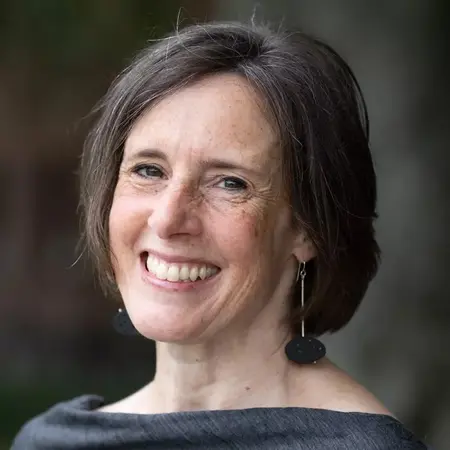
A year after retiring from her position as an English professor at the University of Puget Sound, Julie Christoph was browsing job and volunteer opportunities online. During her search, she discovered a posting for a Peace Corps Virtual Service program working with faculty in Ukraine. Intrigued, she applied, interviewed, and was ultimately accepted.
“I’d been looking for ways to use my skills,” Christoph said. “This program is great for people like me who have some time, but maybe not enough time to pick up and move for two years.”
Christoph’s work is part of a larger, ongoing tradition among Puget Sound faculty who regularly utilize their expertise to tackle global challenges and promote international cooperation. This commitment to continuous learning directly benefits Puget Sound students, as participating in international exchanges allows faculty to gain real-time global perspectives and dynamic teaching practices that they bring right back to their classrooms.
The Peace Corps virtual service model first began during the COVID-19 pandemic when in-person volunteers were evacuated. Fast-forward to 2026, and what started as an emergency workaround has evolved into a thriving way for global outreach. In areas where ongoing conflicts or safety risks make traditional two-year, in-person postings impossible, such as war-torn Ukraine, these virtual postings are more essential than ever. While not traditional on-the-ground volunteers, virtual participants like Christoph are able to deliver their expertise remotely.
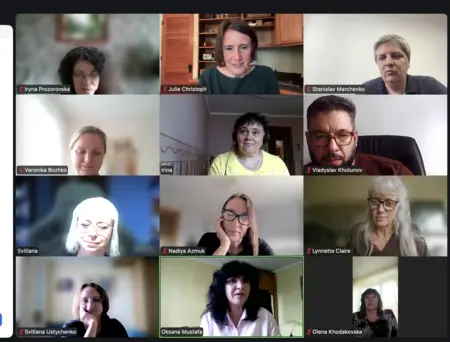
For her project, Christoph organized and facilitated an English-speaking conversation group of 10 participants called the Summer English Club from May through June. The initiative brought together faculty members from a central Ukrainian university, whose name remains undisclosed for safety reasons. Meeting twice weekly, the group offered a supportive space for Ukrainian academics to sharpen their professional English skills for teaching and international conferences.
Each session centered on a professional development topic, such as active learning versus traditional lecturing, mental health and well-being in academia, and the future of the physical campus. Christoph paired discussion with hands-on exercises, using tools like virtual sticky notes and staged debates, while building participants’ English vocabulary along the way.
During that time, she also learned more about the country and the ways faculty were dealing with the Russia-Ukraine war. One story that stuck with her was about a faculty member who attended a conference in Bulgaria. What would normally be a three-hour flight turned into a grueling 40-hour journey each way due to closed airspace, forcing travelers to take lengthy detours by train and bus.
“The faculty members are still actively seeking opportunities for professional development,” she said. “I just had never thought about all that entailed, so that was really striking.”
To expand the impact, Christoph enlisted help from her former Puget Sound colleagues. She invited Chemistry Professor Dan Burgard, Music Professor Gwynne Brown, and Business and Leadership Professor Lynnette Claire to speak to her group — giving Puget Sound faculty a unique opportunity to engage with peers navigating extraordinary circumstances.
“I’m proud of Puget Sound for the professional development work that they do,” Christoph said. “And that’s partly how I knew the faculty members I’d asked — because I had worked with them for years and years — that they were the kind of faculty who show up for professional development, and I knew that they would understand that it was important for the faculty in Ukraine and they’d be up for it.”
Christoph emphasized that part of the Peace Corps’ mission is to facilitate mutual cultural exchange. Ukrainian faculty benefit from exposure to a variety of American voices and accents, while in turn, American faculty gain insights that refresh their own teaching and worldview.
Burgard was invited to speak on the theme “Global Citizenship vs. Brain Drain.”
“Julie and I spoke about the movement within the U.S. trying to get into the ‘best' school,” Burgard said. “The Ukrainians spoke to the stark reality of why many of their country's academics fled and why they stayed. I found the group inspiring as they told stories about teaching during a war and about the folks who stayed and the folks who left with their families.”
Brown was invited to present on public speaking, drawing on her dual career as an academic and a pianist. She shared a video of a performance and, in turn, learned about Ukrainian folk music.
“To welcome me, Julie invited everybody to share a little bit about a musical instrument,” Brown said, “and I learned about some Ukrainian ones I had never heard of, like the buhay.” The buhay is a traditional Ukrainian drum played by pulling on a tuft of horsehair to produce a deep, roaring sound.
Meanwhile, Claire joined a session on “Global Education and Business Trends,” where she reflected on how professional development sustains faculty well beyond the classroom — and how the participants’ resilience affected her personally.
“I could see that the Ukrainian faculty viewed this as an important way to connect with peers,” Claire said. “Seeing each other and having conversation together reminded them of why they do what they do, gave them practical tools to do their jobs, and allowed them to share their practices and perspectives, which helped them stay resilient in their war-torn country.”
Christoph said she wasn’t surprised by the Ukrainian faculty’s strong English skills. What surprised her was their optimism. During orientation, she was warned about power outages, lost internet access, and air raids that might interrupt sessions. The war frequently came up in conversations, but so did the theme of resilience.
“I was not expecting that they would be so upbeat even though they were acknowledging there's some really hard stuff,” Christoph said. “They know people who’ve died, they hear shelling, they need to move to be safe. But they talked about going into the forest. They would go into the forest every weekend to try to get away from the sounds of the war and to hear birds and see flowers.”
Although this session has concluded, the program’s success encourages ongoing virtual collaboration. Christoph shared that if given the chance, she would engage in it again.
“Anytime you get to meet new people from another part of the world, it broadens your horizons,” she said.
By staying actively engaged in global initiatives, Puget Sound faculty demonstrate the value of lifelong learning. Whether retired or currently in the classroom, their experiences abroad continuously enrich the academic environment back home, ensuring students are taught by educators with deep, real-world perspective on global citizenship.
GWA Lifelong Learner Pillar
Stories related to the campaign pillar about lifelong learning