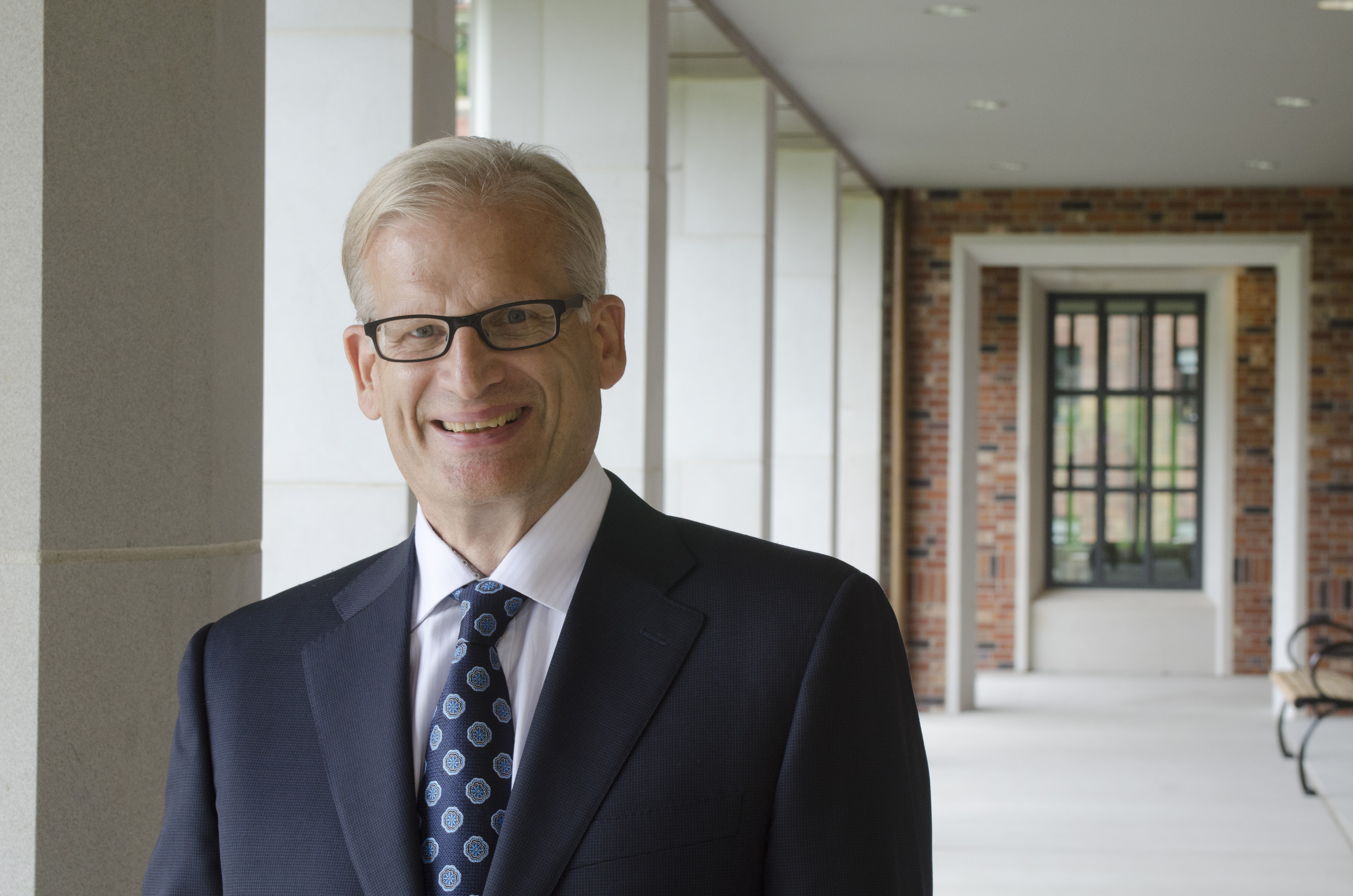
Q: Can you tell me what brought you to Puget Sound?
A: As someone who is committed to this work, I'm always looking for a space that is similarly committed. I spent four years at Whitman College in Walla Walla in the same role that I hold here. I really enjoyed the small liberal arts environment and had the chance to work directly with Dr. Hernandez Jarvis, who retired in June. I knew that this was a place where that commitment was present. I had a sense I could also find belonging in the community outside the institution. Puget Sound has the right combination of place and purpose, so I’m happy to be here.
Q: You’re stepping into this role at a time when there is backlash against the work of diversity, equity, and inclusion. Why do you think supporting diversity on campus still matters?
A: The narratives around diversity, equity, and inclusion have been politicized and weaponized. There's been legislation against this particular type of work at the state level, there's been executive orders at the federal level, and there's been a campaign of misinformation. People have used the lack of clarity surrounding what this work is to challenge its legitimacy. I think we're in a really unique moment historically. I cannot think of a time when a specific profession encountered so much hostility. Ultimately, I actually don't think we're talking about diversity on campus in the sense of demographic composition.
For me, this work is about institutional excellence and viability. To effectively attract and retain talented staff, faculty, and students, we need to be a place that explicitly values everyone and pushes against narratives of dehumanization and histories of oppression. If you're a place where a person doesn't feel welcome, they will not be in your applicant pool. If you have a reputation for being unwelcoming or harmful to particular populations, those people will avoid your institution. And if they do enter, then they're going to just turn around and leave — it becomes a revolving door. When you deny yourself access to talent, you undermine your own institution's opportunity for excellence. The fact is that higher education institutions that are not inclusive are at risk of dissolving.
Q: What does the word “belonging” mean to you?
A: It means a lot. Belonging is embedded in my principles for inclusive excellence, which include diversity without dominance; equity without benevolence; inclusion without othering; belonging without assimilation; and a commitment to cultural humility, cultural pluralism, and cultural wealth. Belonging is a key piece of that, and particularly belonging without assimilation. There's a quote by john a. powell, who is the director of the Othering and Belonging Institute at Cal Berkeley. He talks about othering, which is dehumanization, exclusion, minoritization, and microaggressions, and he says the opposite of othering is not same-ing, but belonging. So belonging isn't just welcoming people, it's about adapting and changing an environment in order to make sure everyone belongs.
Q: How can we all contribute to creating a campus culture where everyone feels like they belong?
A: I think we can all contribute to belonging by embracing a culture of learning and a community of accountability. I don't mean accountability in any kind of a punitive way, but in a supportive way. There's a story I tell about how I was trying to stop using the word “guys” to refer to groups of people of mixed gender. “Guys” was just so embedded in my regular speech patterns that I was going to give up. And my friends said, “No, John, we believe too much in your humanity to give up on you.” So, they let me know every time I said “guys” and held me accountable so that I could do the thing I said I was committed to and use more inclusive language. It’s not about calling people out or cancel culture, but it is more about helping people grow into the kinds of peers, friends, colleagues, and allies they want to be.
Q: How do you spend your time outside of work?
A: I'm new to the region, even though I spent several years on the east side of Washington. So, I'm still trying to build my immediate local community. I'm a cinephile, so I'm very much into films. In fact, one of my friends gifted me a membership to the Grand Cinema. And that’s connected to my scholarship, which is focused on racecraft and representation in the Marvel Cinematic Universe. I'm actually working on a book manuscript about racial messaging and representation in the MCU that I'm hoping to finish very soon.