Exploring the Biology Behind Human Ritual and Imagination
To many, science and magic sit on opposite ends of a spectrum. One relies on empirical data, peer-reviewed hypotheses, and logic. The other invokes unseen forces, intuition, and rituals. But for Siddharth Ramakrishnan, professor of biology and the Jennie M. Caruthers Chair of Neuroscience at the University of Puget Sound, the two worlds are intimately connected.
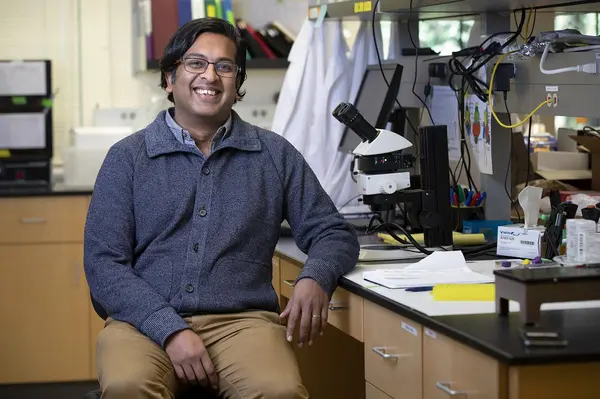
In a liberal arts environment that encourages cross-disciplinary exploration, Ramakrishnan embodies the spirit of inquiry by bridging rigorous academic science with human art and mysticism. In his new book, The Neuroscience of Magic: How Your Brain Is Wired for Intentions, Spells, and Dreams, Ramakrishnan explores how everyday rituals, magical thinking, and manifestation are not contradictions to biology, but rather reflections of how our brains are naturally wired. This is a follow-up of his 2024 book, The Neuroscience of Tarot: From Imagery to Intuition to Prediction.
“While the tarot book was something which touched a lot about my adult practices, in this process I realized that I had grown up with a lot of magical rituals in my childhood,” Ramakrishnan said. “So on some level, the new book is a reconnection with my own growing up and my past.”
Ramakrishnan notes that our inclination toward magical thinking often increases during periods of collective uncertainty.
“I think some of it comes from the uncertainty of life,” Ramakrishnan said. “And that's kind of what's going on right now in our world is I think a lot more people believe in magical practices because of the uncertainty that's surrounding them.”
Interestingly, Ramakrishnan points out that this pattern-seeking, out-of-the-box ideation isn't separate from scientific discovery. Scientists themselves often rely on lab totems, lucky charms, or routines born from experimental uncertainty — a reality he often highlights when teaching undergraduate students how science is actually practiced.
“On some level, I think inspiration in science also comes from that same source of magical thinking,” Ramakrishnan said. “If you think about a scientist's exploration, sometimes you come up with these ideas that just are out of the blue, but once you have that idea, you then try to connect the dots as to how can I go from point A to point B.”
In his classroom, Ramakrishnan urges students to look beyond textbook definitions and explore the mechanics of how we perceive the world. He encourages students to connect what they learn about visual imagery, stories, and how emotions show up in the body — like tracking stress or anxiety through muscle tension and gut feelings — with their own life experiences.
In his book, he explores how the human brain changes its view of the physical world based on context. A piece of wood or a stone is just an object until someone decides to see it as a wand or a crystal.
“The way we view that same entity changes by how our brain reframes it,” Ramakrishnan said. “And I find that contextual switch to be very fascinating. How we are able to do this is something that I try to explain in the book.”
When it comes to goal setting or manifestation, Ramakrishnan emphasizes that real psychological and physiological shifts require physical action, not just passive thought.
“So instead of always thinking about it, if you do something physical about it, then your brain starts adding value to that particular moment in time and saying, 'Hey, I'm actually using my hands or my words in order to do this particular task,'” Ramakrishnan said. “That means it's important to me, so I want to pay more attention to it and so it's going to become much more successful at what you're doing.”
Ultimately, Ramakrishnan hopes the book empowers readers — and the curious learners he teaches — to understand their cognitive wiring, build confidence, and live with greater intention.
“A lot of people think that they're not capable of that transformation or they don't have the ability to have powerful intentions,” Ramakrishnan said. “But knowing that all of us have these brain circuits, all of us have these capacities, I think will give folks the agency to act or at least retrain their brains to become a little bit more intentional about their practices.”