Alumni, Arches

Fifty years later, the ‘tall and talented’ Loggers who won the university’s first national championship reflect on the moments and mindset that brought the banner home

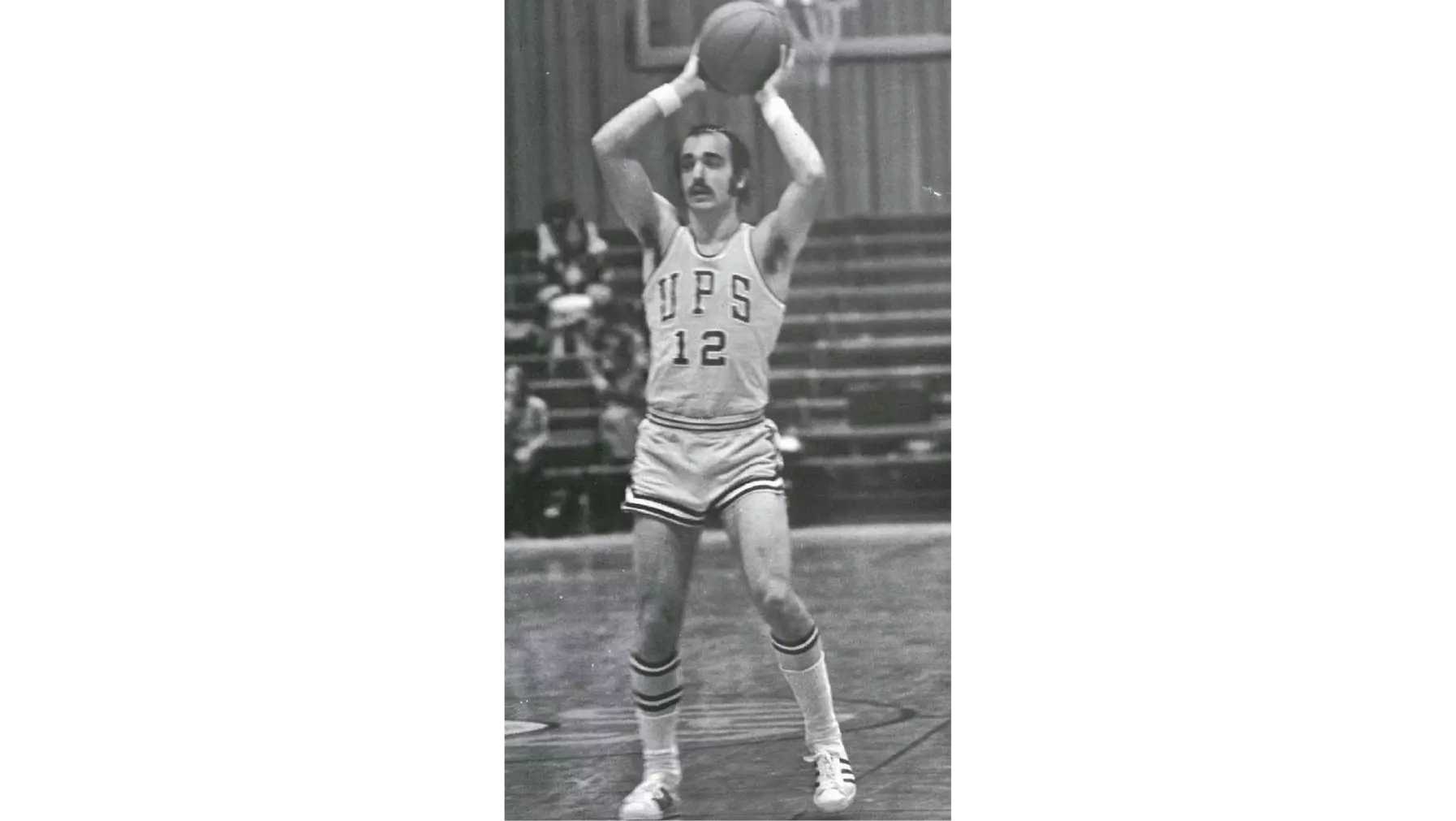
Matt McCully ’78 was an end-of-the-bench guard who took the court only for the final minute or so of the University of Puget Sound Loggers’ 1976 NCAA Division II men’s basketball national championship game victory over the University of Tennessee-Chattanooga. Yet, it was McCully who found himself on the shoulders of his teammates after the buzzer sounded on an 83–74 triumph that long-ago March evening at Roberts Stadium in Evansville, Indiana. “They didn’t have ladders back in those days, apparently,” McCully recalled with a laugh. “They hoisted me up and then I cut the net down.”

There was a practical aspect to McCully’s ascension: “I was the littlest guy on the team, 5-foot-9,” McCully said. But that wasn’t quite it, entirely. “He wasn’t just some random short guy on a tall team that we decided to lift up,” starting guard Rocky Botts ’78 said. “He was every bit as much a part of that as those who played more. His role was to be the de facto team leader. Everybody deferred to what Matt had to say.”

Many of the Loggers who played that championship season agreed that in addition to its talent, the team triumphed because of the bond it developed. “Never have I been on a team like that, where every single guy wanted every single guy to succeed,” Botts said. “We were and are, literally, the best of encouraging friends to this day. We share a unique history, bond, and depth of camaraderie that we all continue to nurture and cherish these many years later.”
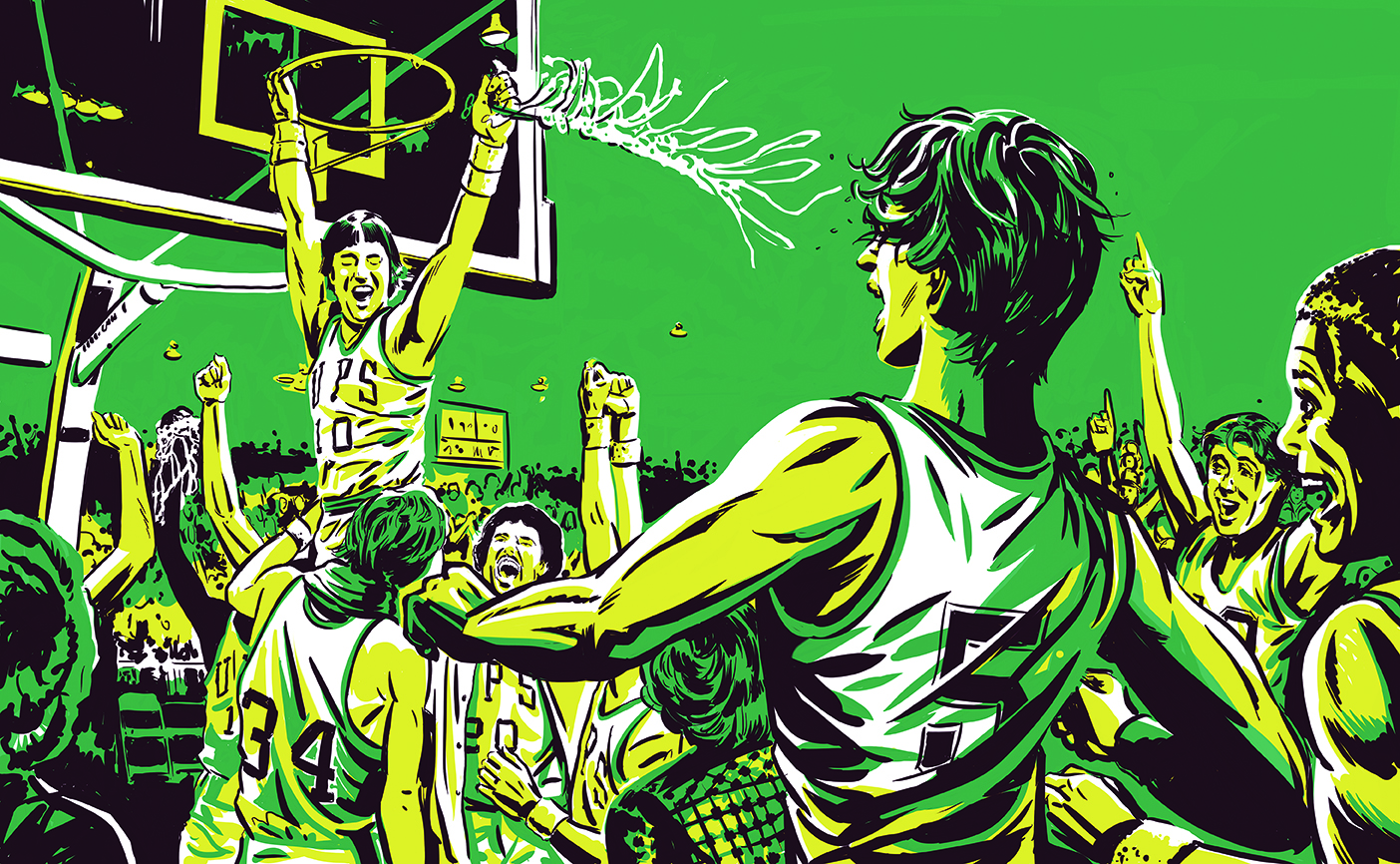
1976 NCAA Division II men's basketball champions. Illustration by Jonathan Carlson.


McCully said he never felt less important than the starters. “Off the court, everybody just liked each other,” McCully said. “I give a lot of credit to the stars on the team. They never treated any of us as though we were less important.”

It was a different time, a different world. There’s a photo of the Loggers with their championship trophy, their leisure suits, and their bushy mustaches. Gerald Ford was president of the United States. College basketball had no three-point line, no shot clock, and no dunking. Competitive collegiate women’s sports were in their infancy; Title IX had just been implemented in 1975.

As the 50th anniversary approached of “the greatest thing to ever happen at the University of Puget Sound” — as then-Athletics Director Doug McArthur ’53 described it in a postgame interview with The Tacoma News Tribune, back on March 19, 1976 — the members of that 1975–76 NCAA Division II national championship men’s basketball team reflected on a bond that has endured for half a century.

‘EVERYBODY WAS SUPPOSED TO GO SOMEWHERE ELSE’

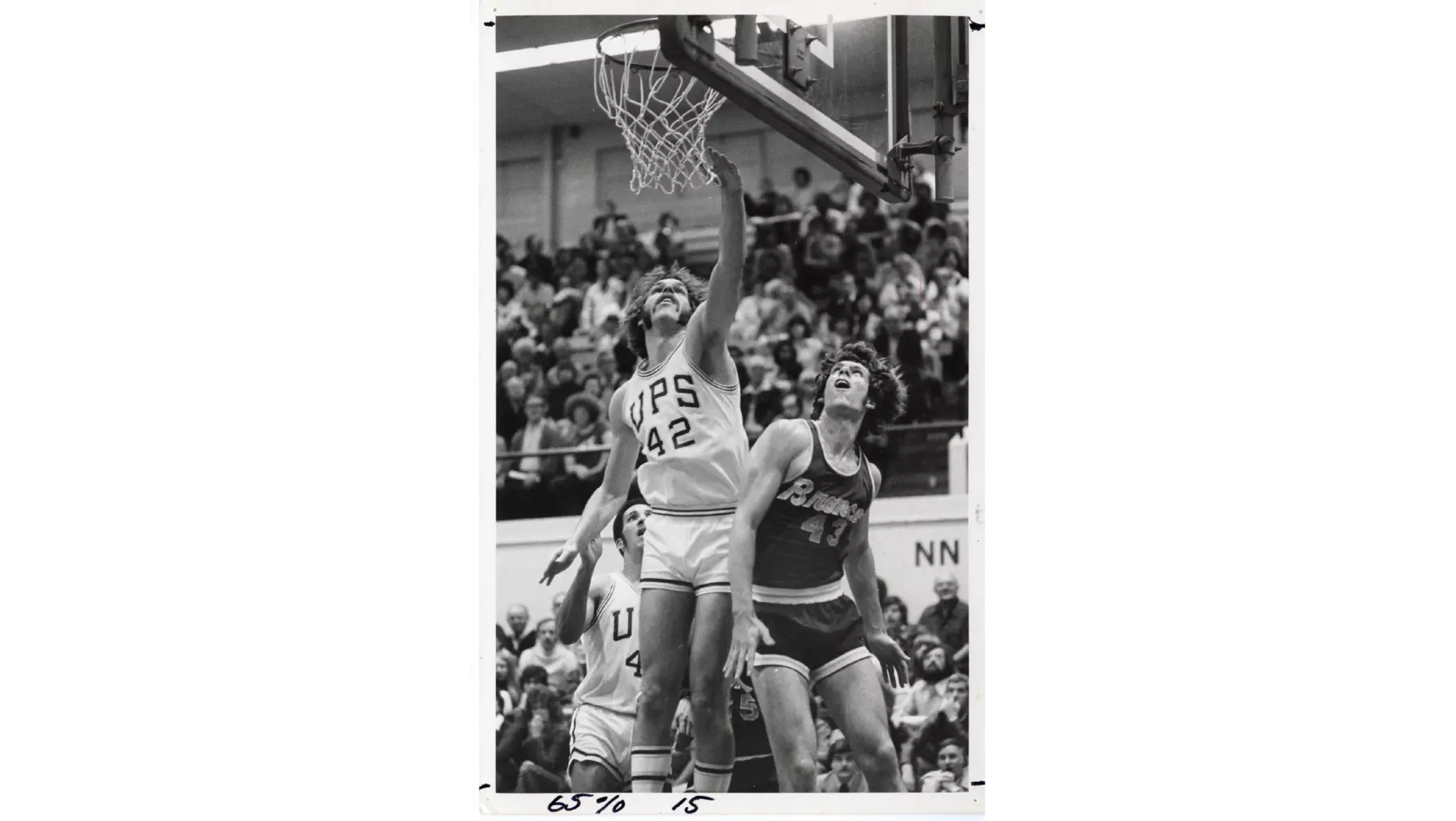
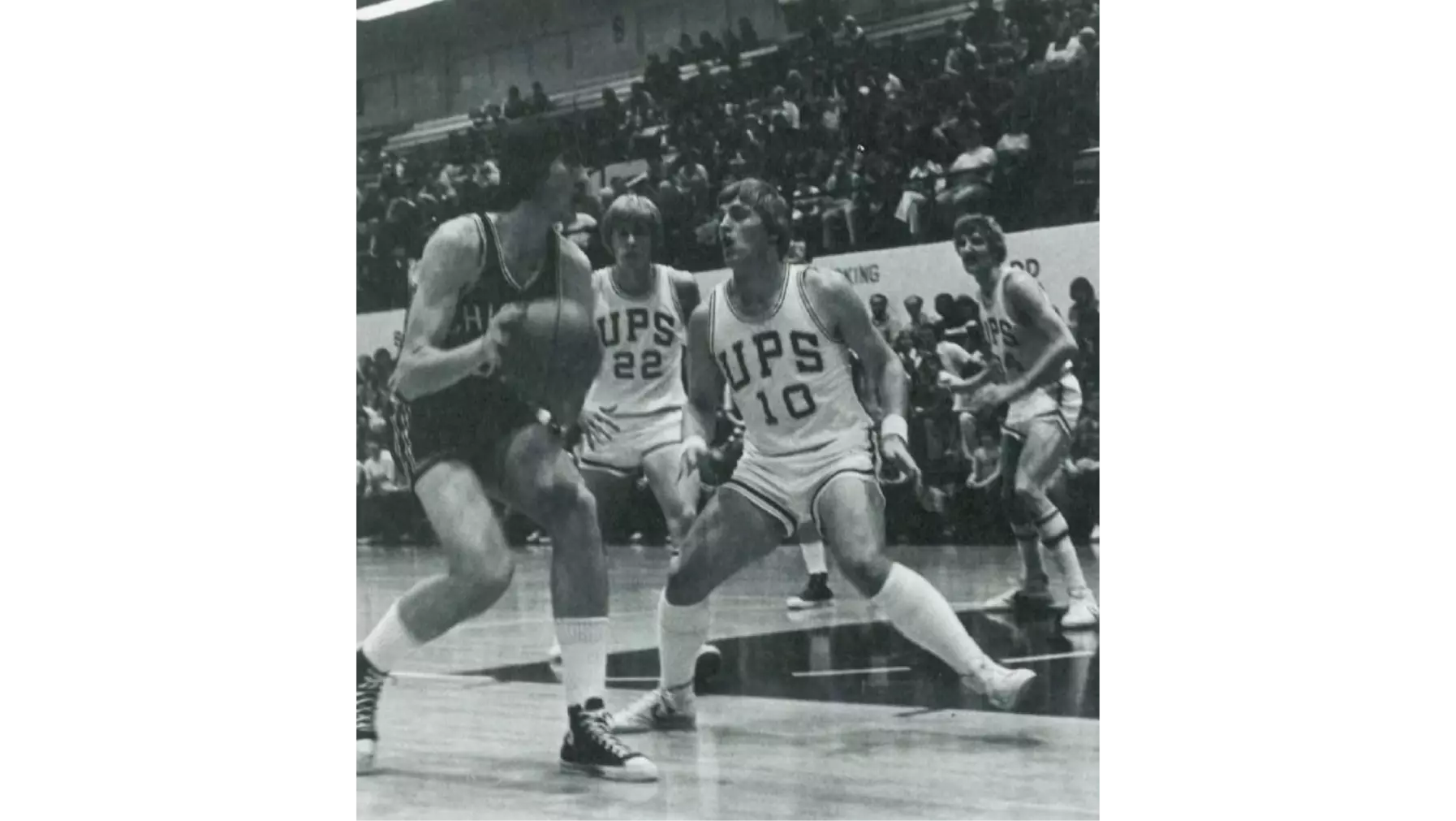
In the mid 1970s, Logger Athletics had lofty aspirations. Under the direction of Puget Sound Athletic Hall of Famer McArthur, who died in 2023 at age 94, baseball was Division I and basketball was looking into making such a move. The ’76 Loggers became national champions — the first basketball team from Washington to do so — because they were tall and talented, setting school records that still stand, with a 27–7 record and 13 successive wins to close the season.

Forward Rick Walker ’78 remains Puget Sound’s all-time leading scorer, with 1,946 points in 120 games, guard Tim Evans ’78 is second with 1,929 in 121 games, and 7-foot center Curt Peterson ’76 ranks fourth with 1,620 in 95 games.

The architect of the championship team was head coach Don Zech who, along with assistant Mike Acres, recruited from across the state and was unafraid to vie against bigger Division I schools. All five starters on the title team came from Washington high schools.

Walker was a 6-foot-5 shooter with a quick release, who led East Bremerton High to the AA state title and signed to play for Division I Boise State. As East Bremerton was savoring its triumph, Zech introduced himself and told Walker: “We feel we have a real good shot at winning the NCAA Division II championship, if we had the right players. You’re instrumental to seeing that happen.”

“That caught my interest a little bit,” Walker said. He decided he wouldn’t mind playing closer to home.

Botts was sure he was going to be a University of Washington Husky until a disappointing senior year in high school, after which he stopped hearing from the coaching staff. “Tim was going to go to Washington State. Rick to Boise State. Brant was supposed to go to Cornell. I was going to go to Washington, but the phone didn’t ring,” Botts said. “Everybody was supposed to go somewhere else. There just seemed to be a reason we were all there.”
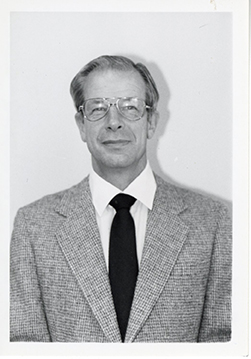
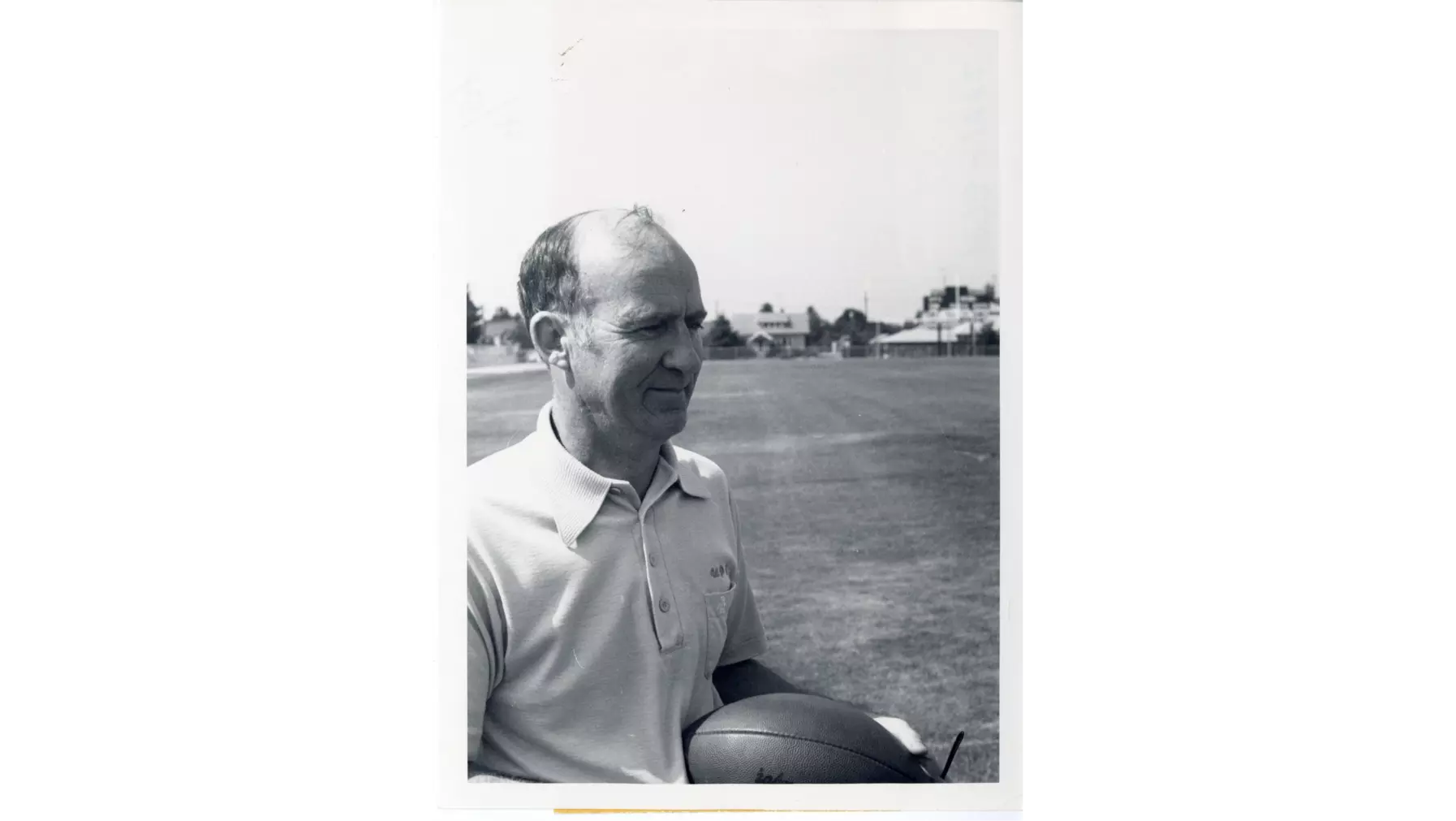
Men's Head Basketball Coach Don Zech in the 1970s.
In his 21 years as the Logger men’s basketball head coach, Don Zech amassed a 405-196 career coaching record and led the team to 11 postseason appearances, two Great Northwest Conference titles, and the national championship in 1976, when he was named National Coach of the Year.

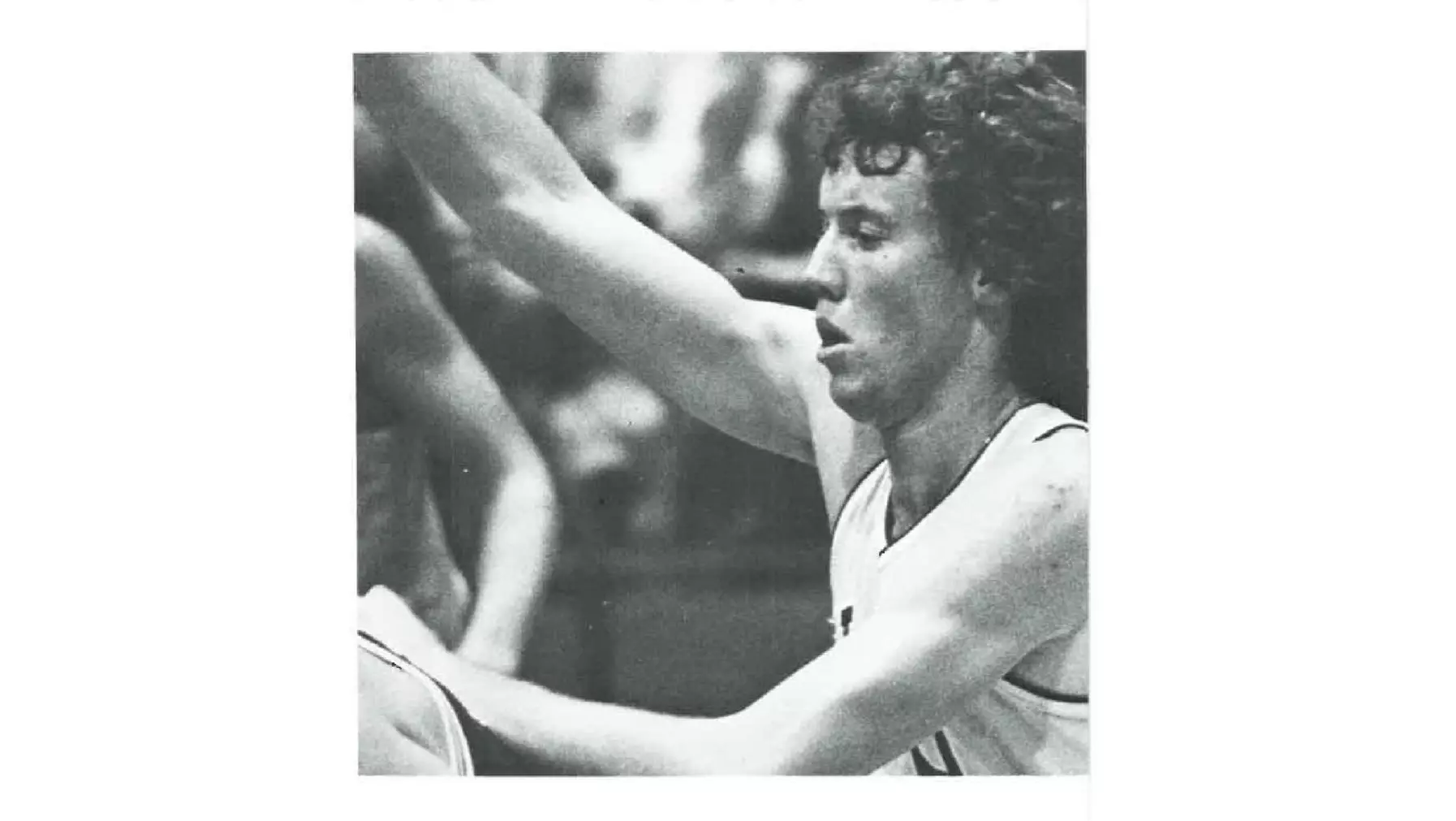
No one regretted signing on once the team came together. “Coach Zech knew his personnel, and he did a good job — a really good job — of putting together the right combination, finding the chemistry,” Walker said. “But I think the players, for the most part, weren’t in it for their own personal gain.”

Did Walker think, before the season started, that the 1975–76 team could win a national championship? “Zech did,” Walker said.

“Zech said early on, after the first couple of games, that this team is going to win it all,” recalled Ed Bowman ’57, P’86, P’93, who was then the dean of admission at the university. He and McArthur called the games on radio and sometimes TV, when the games were tape-delayed and shown on Saturday evenings. “The way they were playing, certainly I believed it. He was a wonderful, wonderful coach.”

In filling out his roster, Zech wasn’t afraid to think outside the box. Forward Anthony Brown ’76, a key reserve who would go on to a long pro career in the Netherlands, didn’t play high school basketball in Compton, California. He came to Puget Sound because his older brother was a football player for the Loggers. Zech watched Brown playing intramural basketball. “He asked me, ‘How would you like to try out for the team next year?’”

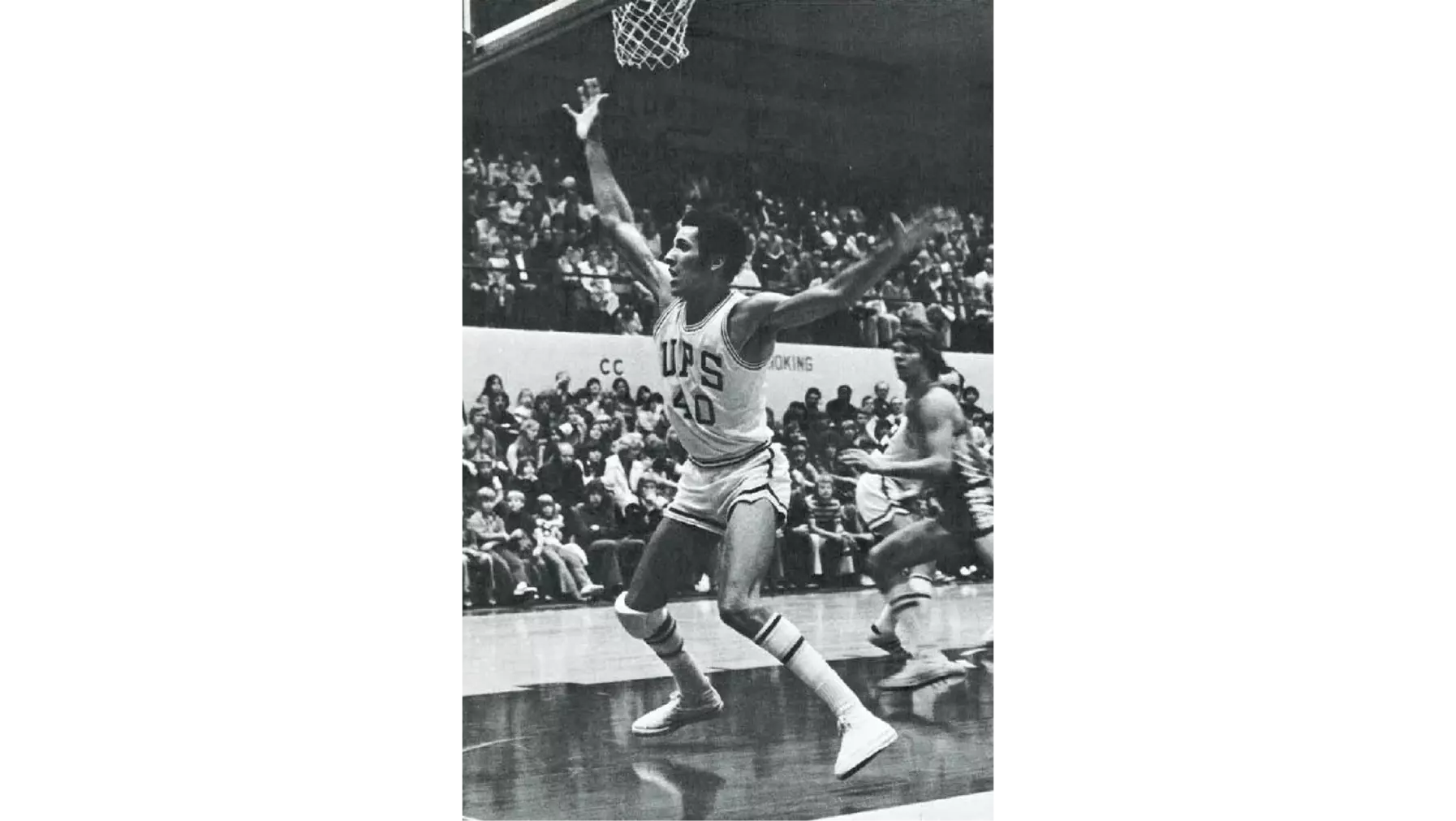
Brown, smooth and versatile at 6-foot-7, became a player Zech would lean on heavily if a starter was in foul trouble or injured.

‘HE WAS RELENTLESS’

Zech, who died at age 83 in 2016, was head coach at Puget Sound for 21 years, stepping down in 1990. He won more games than anyone in school history, compiling a 405–196 record after leaving the University of Washington, where he was an assistant, in 1969. Zech was named the National Association of Basketball Coaches Coach of the Year in 1976 and was inducted into the Logger Athletics Hall of Fame in 1991.

His former players speak fondly of Zech today, but their feelings weren’t always so cozy. Zech was a demanding coach. “He didn’t suffer fools easily, that’s for sure,” Botts said. “He was relentless.”

“Coach Zech, let’s say for 60 percent of us, he was an acquired taste,” starting point guard Mark Wells ’76 said. “You had to do your job, and if you didn’t like the job you were chosen to do, you didn’t play very much. And yet, Coach Zech was basically a genius. He had a knack for knowing how to put the right people in the right places at the right time, and you had to get used to it.”
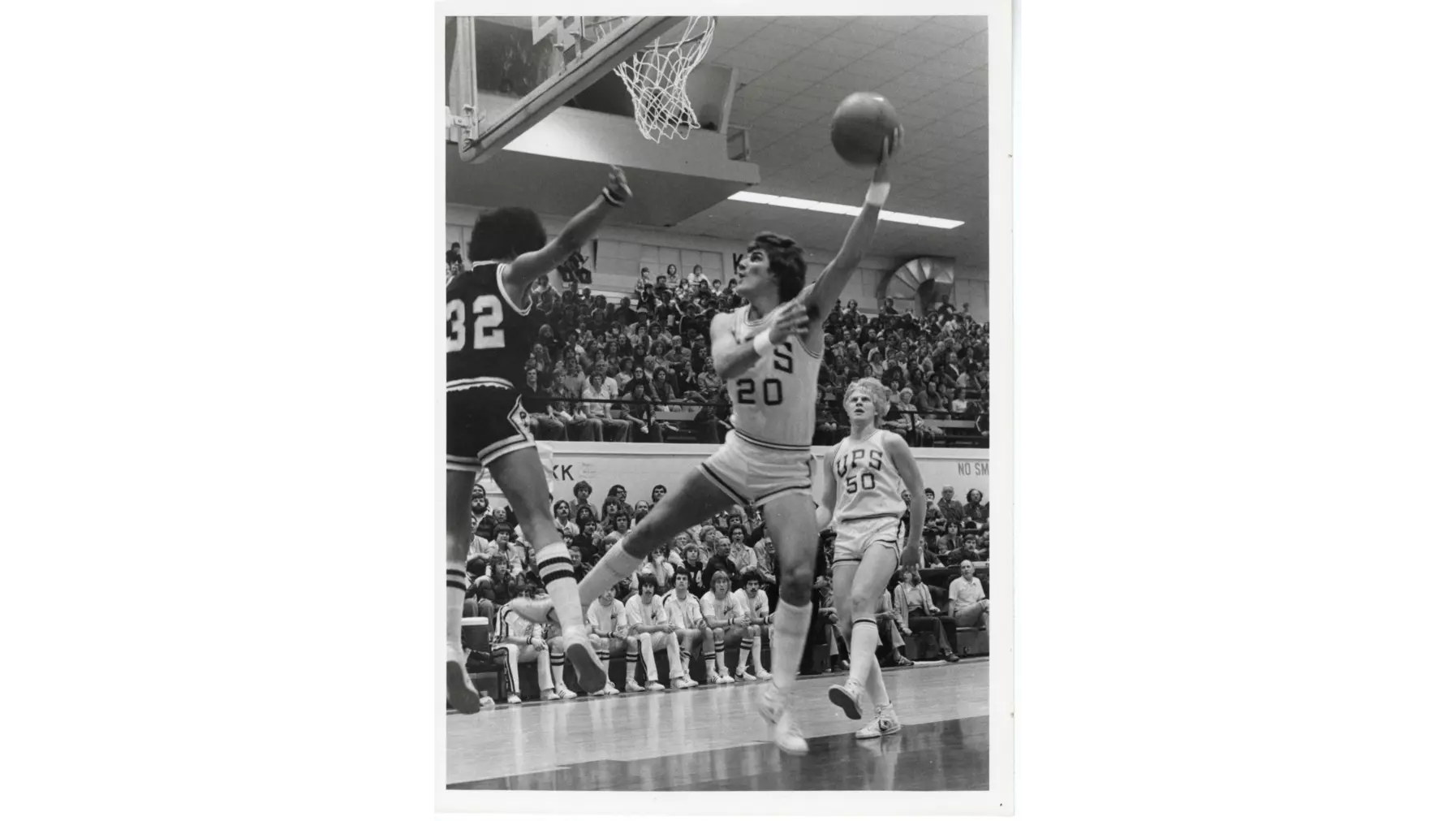
"[Head Coach Don] Zech said early on, after the first couple of games, that this team is going to win it all."

- Ed Bowman ’57, P’86, P’93

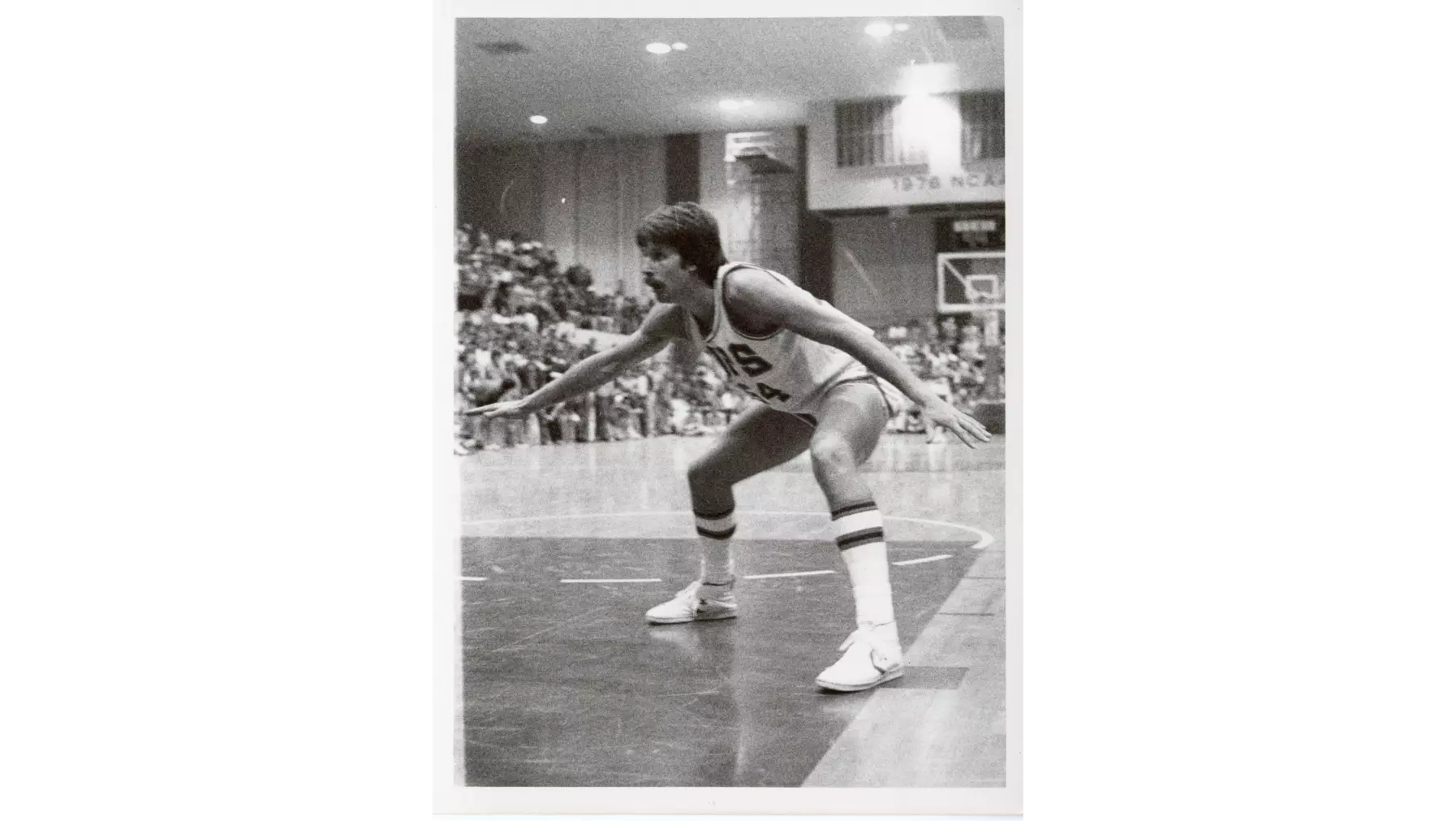
Botts had been a hot-shot scorer in high school, like most of the Loggers, but his eventual role at Puget Sound was as a defensive stopper. “They didn’t need another guy chucking up shots. Curt and Rick and Tim could all just really fill it up,” Botts said.

Wells, a 1972 Curtis High School graduate and all-state point guard, transferred to Puget Sound from Montana, where he played a year of basketball for legendary coach Jud Heathcote. When the three-sport athlete came to Puget Sound, he started for the football team for two years and did four years of track, but he had to sit out the basketball season under the NCAA rules of the time. Watching from the bench that year, he was impressed by his new teammates.

“After I transferred in, my sophomore year, we brought in like five all-state high school players. They were all used to being the top dog at their high school,” Wells said. “Ten of our top 12 players on the championship team were from the state of Washington. It was a really good formula. A lot of pride on that team, to win something for the state of Washington.”

Peterson, the 7-footer with a feathery left-handed shot, was named most valuable player of the Division II tournament. He said of Zech: “A very tough coach. He wanted the best out of us, always. He was willing to do what it takes to get that, but he also cared about us and was willing to help us out.”

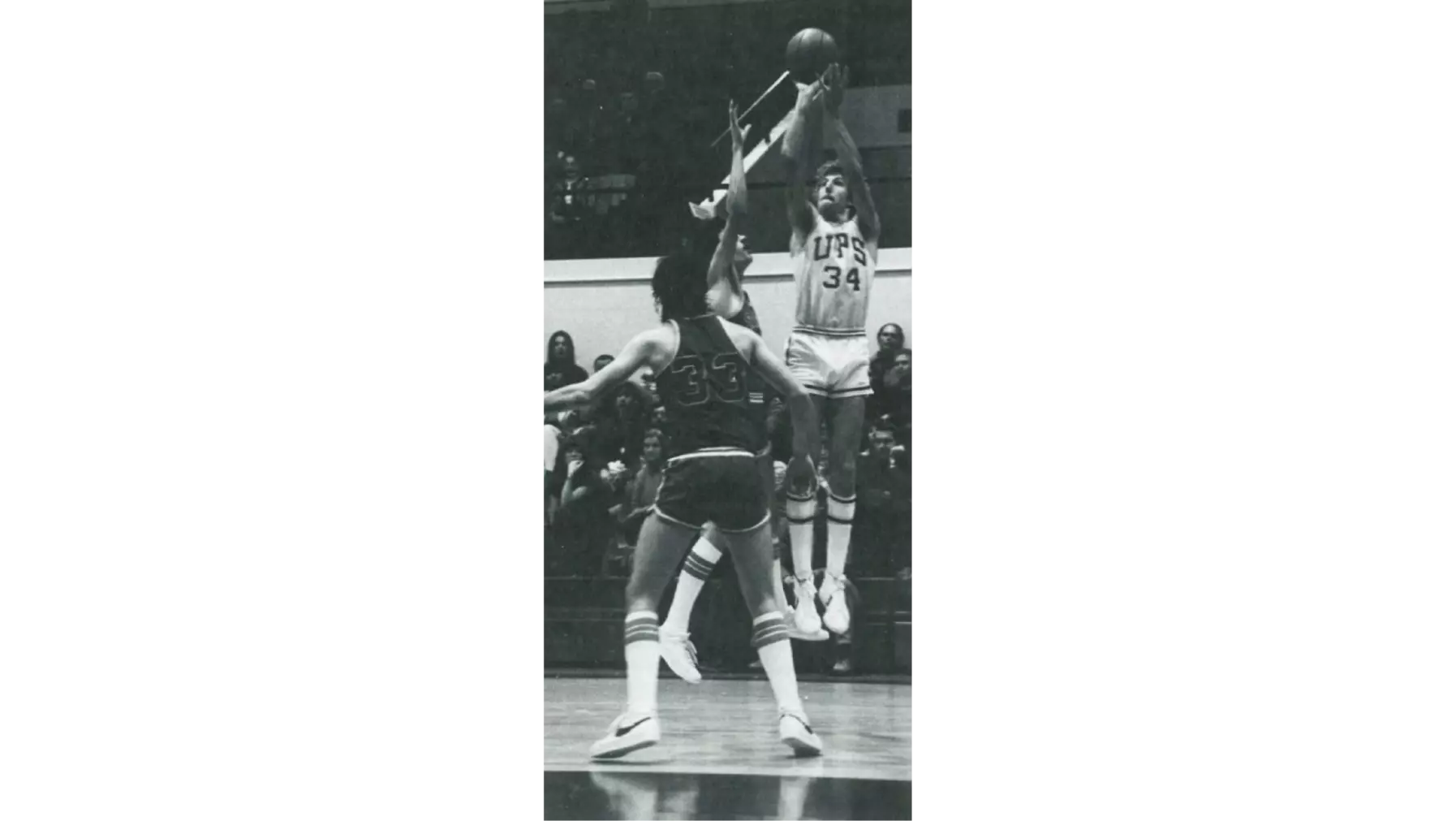
McCully said that Zech “talked about recruiting guys who could shoot the ball.” The title team shot a school-record 50.8 percent from the field. “He said, ‘I can teach guys to play defense, I can teach ’em to rebound, I need guys that when we run the offense, when they get open, they make baskets.’ And we had some. We just had great shooters.”

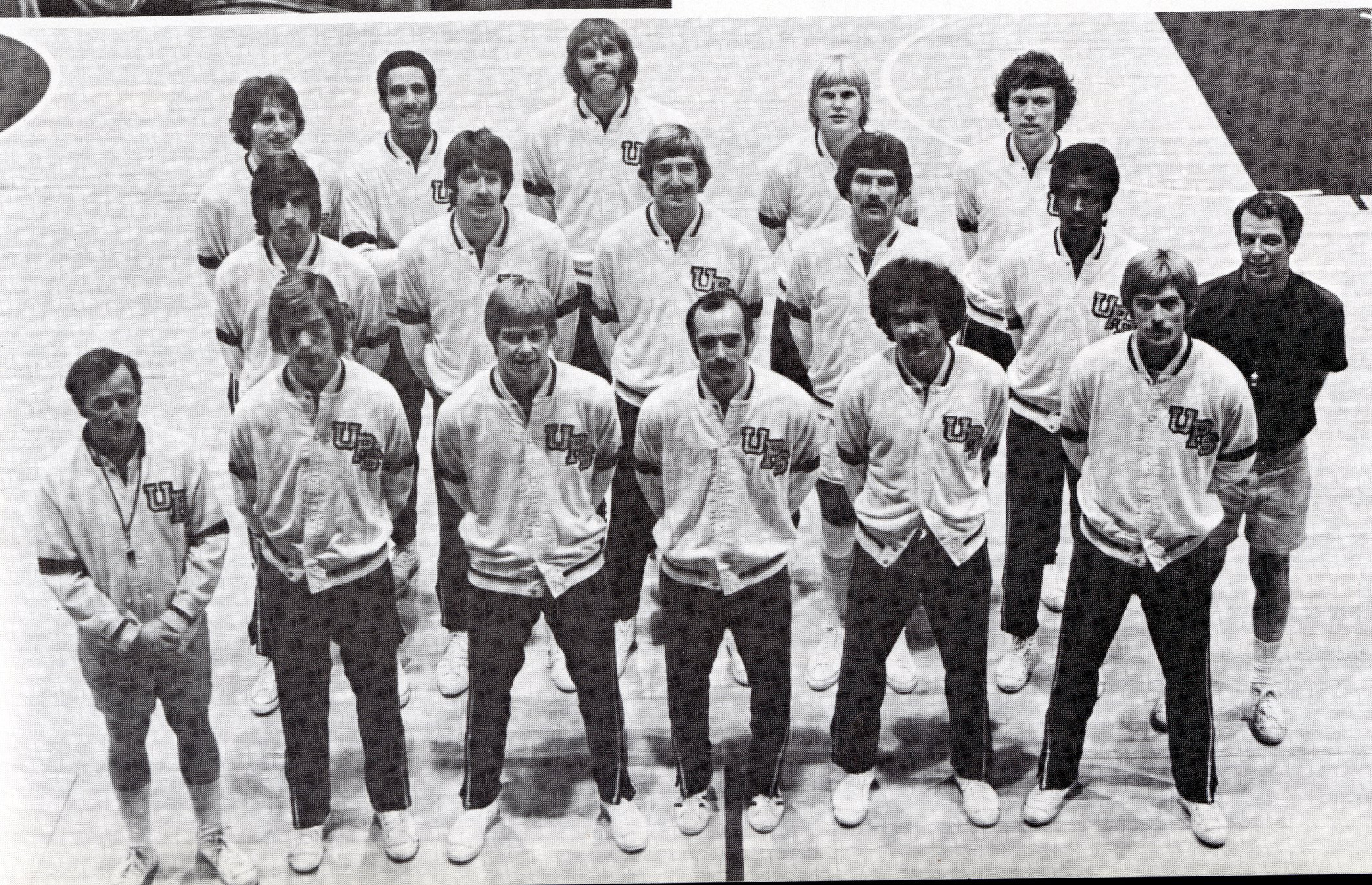
1975–76 Men's Basketball Team
The 1975–76 men’s basketball team included student-athletes Rocky Botts ’78, Anthony Brown ’76, Tim Evans ’78, Steve Freimuth ’78, Brant Gibler ’76, Mike Hanson ’78, Phil Hiam ’79, Mike Kuntz ’78, Matt McCully ’78, Curt Peterson ’76, Jimmy Stewart ’78, Mike Strand ’79, Rick Walker ’78, and Mark Wells ’76; as well as head coach Don Zech, assistant coach Mike Acres, and athletic trainer Zeke Schuldt ’68. 

The entire team was inducted into the University of Puget Sound Athletic Hall of Fame in 2003. Zech, Schuldt, Peterson, Walker, and Evans were also inducted individually.

THE PATH TO THE TITLE 

After fairly easy Division II tournament victories over Cal Poly Pomona and Cal State Bakersfield, the Loggers hosted North Dakota in the quarterfinals. Bill Baarsma ’64, P’93, Hon. ’23, who taught at the university from 1968 until 2001, recalled vividly the tightest tourney game the Loggers played en route to winning it all.

“It was standing room only at the fieldhouse, something to behold,” he said.

Puget Sound led by one and had the ball in the final half-minute, but a pass drifted just a little too far even for Peterson’s long arms, and North Dakota took over with 14 seconds remaining. North Dakota’s ensuing final-seconds shot to take the lead looked good, from where Baarsma sat.

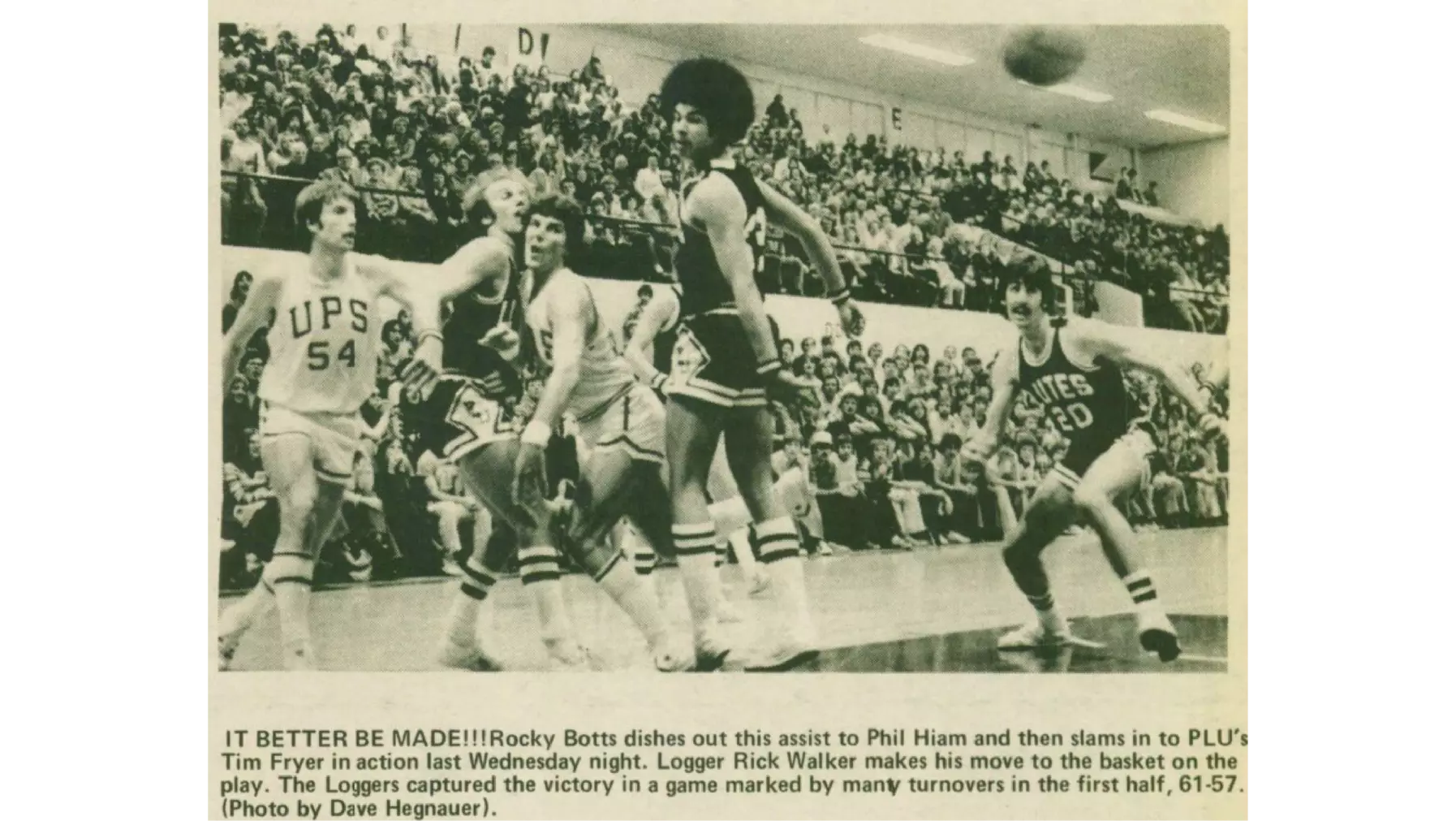
“That ball was going in. It bounced around and around and around the rim before dropping out. Rick Walker grabbed the rebound, and he was fouled,” Baarsma said.

Walker, who stepped up for two free throws, took pride in his rebounding prowess. He wasn’t thinking about the shot going in, as he moved into position. “I never think they’re going to go in,” he said. “I anticipate where I think the ball’s going to go, if it misses.”

Botts recalled McArthur calling that 80–77 victory the best game ever played in the Memorial Fieldhouse. Wells added: “That was probably our national championship game right there.”


UNDERDOGS IN EVANSVILLE 

Just making a national collegiate basketball championship final at any level was an achievement. Baarsma noted that only five teams from Washington had ever made it that far. The Loggers weren’t favored, either in their semifinal matchup with Old Dominion or in the finals against Tennessee-Chattanooga. The perception was that they were too slow.

“The newspapers talked about Paul Bunyan of the Northwest not being able to keep up,” Bowman recalled.

Brant Gibler ’76, a forward, remembered the team bus pulling over on its way to the semifinal game, so the Old Dominion bus and its police escort could pass. “Nobody thought we had a chance,” Gibler said. “But we knew we did.”

Against defending champs Old Dominion, Botts, normally the defensive specialist, helped get the Loggers out of the gate with five first-half long bombs.

The toughest challenge, however, fell to Peterson. Wilson Washington, who was the tournament’s MVP the previous year and would go on to play in the NBA after being drafted by the Philadelphia 76ers, was smaller than Peterson, at 6-foot-9. But “he was much quicker,” Peterson said.

“I was thinking to myself, ‘How am I going to defend this guy?’ All I could do was try to outsmart him; I wasn’t going to outdo him physically. I remember him trying to back me down. Instead of giving up ground, I held my ground. He knocked me down, they called an offensive foul, twice. So they had to take him out of the game.”

As the game progressed, Peterson discovered something. “I could score over Washington. I had a nice little left-handed hook shot. He couldn’t block that. They ran me around the screens for those nice little outside shots. He never came out on me on those.”

Peterson outscored Washington, 18–10, and the Loggers advanced with an 83–78 victory.

Peterson went on to be drafted by the Detroit Pistons, but he was cut in training camp and then played professionally in Sweden.

"Nobody thought we had a chance, but we knew we did."

- Forward Brant Gibler ’76

Vanquishing Old Dominion didn’t gain the Loggers a lot of respect from the media, however, or from the Tennessee-Chattanooga Mocs. Just about everyone from Puget Sound interviewed for this story recalled the T-shirts Tennessee-Chattanooga fans wore to Roberts Stadium: BEAT PUNY SOUND.

The Mocs thrived on full-court pressure. But Zech’s team had spent countless hours practicing how to beat a press. “They were full-court pressing us, because they didn’t think we could get the ball up court,” Wells said. “Thank God, they kept it on the whole game.”

“We were just bigger and better than they were,” Botts said. “It was no fluke. We threw over top of them the entire game.”

The Loggers took the lead for good with 5:54 left in the first half and cruised to an 83–74 victory. Like many opponents, the Mocs found it hard to score over Puget Sound’s tall, active matchup zone.

Gibler, a self-described “wiry garbageman” who was not usually a big scorer, tossed home 22 points, going nine-for-12 from the field. Peterson added 20, shooting eight-for-11.

‘UNBRIDLED JOY’

And when the final buzzer sounded? “Unbridled joy,” Botts recalled.

There were maybe 100 or so Loggers fans who had made the journey to Indiana, many of them family members of the players. “Unlike some championship games where the fans fill the floor, we didn’t have enough to storm the floor,” Walker said.

Back on campus, 2,200 miles northwest of Evansville, though, there were plenty of celebrants.

“I remember people telling me that while the game was being played, they would have the radio on, hook it up to the big stereo speakers in the frat houses, the dorm hallways, and every time somebody would make a bucket, they’d all jump up and start pointing at the speaker,” Wells said.

One of the people telling him that was Colleen McKay Wells ’77, his soon-to-be wife, who was a member of the inaugural Puget Sound women’s basketball team in 1973.

“As soon as the game was over, everybody stepped out of their dorm rooms or their frat or sorority houses, and the whole campus erupted,” Wells recalled her saying.

There was a memorable celebration in the team hotel that night, and plenty of bleary eyes filing onto the Continental Airlines flight that took the Loggers back home, through a layover in Chicago.

“Getting on the plane the next morning was no easy task,” Botts said. “That was one special night.”

Peterson treasured his perk from being named tourney MVP — an upgrade to first class. “I could stretch my legs,” he said.

Back at Sea-Tac, a decent-sized group of fans greeted the flight, several Loggers recalled, but there was no victory parade or formal campus celebration. The champions got Bulova watches engraved with the details of their accomplishment.


BITTERSWEET AFTERMATH 

Following their unlikely success, Logger Athletics took a different approach after 1976. Schools the Loggers had beaten to win the title, like Old Dominion and Tennessee-Chattanooga, quickly ascended to Division I. Puget Sound, which had gone 5–6 against Division I teams during its championship season, scrapped its advancement plans and instead went first to NAIA and then to Division III.

“After I graduated, I came back, sat down and talked to Doug [McArthur],” Wells said. “He was just heartbroken that [the move to Division I] didn’t get done. We were on the cusp. It just didn’t happen.”

Teammates said administrators at the time had raised concerns about athletics being emphasized at the expense of academics. But Bowman recalled: “They were good guys and good students. The coup de grâce that really made my chest bulge, especially being dean of admissions, was that all 15 players graduated.”

THROUGH THE YEARS 

Just about all the national champions remain in contact 50 years later. They show up for one another in times of grief. They hold regular reunions, and they are far from forgotten in the region.

“When I’m in Tacoma, and we get together for some university function, there’s always memories — ‘Oh, I was there, I was in the stands!’” Walker said. “It’s still there. You run into it. You feel pretty good about what we accomplished, and the fun that we had.”

“All these guys were just great teammates,” McCully said. “Still, when we get together, we just all laugh and reminisce and tell lies about how good we were.”

“The older you get,” Wells said, “the more important it becomes.”


Les Bowen is a mostly retired sportswriter who spent much of his five-decade career working at the Philadelphia Daily News and The Philadelphia Inquirer. He told the Arches team he really enjoyed learning about the 1975–76 Loggers and their memorable journey to the national championship.

Champions Abound

The 1975–76 men’s basketball team isn’t the only Logger team to go to the heights at the conference or national level. While a comprehensive list of other Logger champions would be too long to list in print (Go Loggers!), we asked our Athletics team to share some standout seasons and performances:

WOMEN’S TEAMS

2002–03 & 2023-24 BASKETBALL
Northwest Conference champions

2024–25 CREW
Seventh-place finish at NCAA DIII championships

2007–08 GOLF
NCAA DIII championship tournament appearance

2002–15 SOCCER
Fourteen straight NWC championships

1990–91 & 1994–95 SOFTBALL
Second-place finish at NAIA championships

1988–90 SWIMMING
Six individual national champions

2024–25 TRACK AND FIELD
Lizzie Beiswanger ’27 —14th nationally in 400m
Kyrstin Wilson ’26 — 20th nationally in 100m

1993–94 VOLLEYBALL
NAIA national champions

MEN’S TEAMS

2024–25 BASEBALL
First-ever NWC appearance

1975–76 BASKETBALL
NCAA DII national champions

2024–25 CROSS-COUNTRY
Ben Kerr ’25 — NCAA DIII championship qualifier

1982–83 FOOTBALL
Evergreen League champions

2013–14 SOCCER
NCAA DIII championship tournament appearance

1994–95 SWIMMING
Six individual national champions

1965–66 TENNIS
Evergreen Conference champions

2024–25 TRACK AND FIELD
Alex Rhodes ’27 — NCAA DIII 400m national champion

Want to share your memories of a championship season? Email arches@pugetsound.edu