A Girl Scout outing set Cindy Rogers on her path to a career in occupational therapy.
“I was an avid Girl Scout through high school,” recalls Rogers, who grew up in small-town Utah. “One year we did career study.”
That included a visit to a Utah state facility for people with disabilities, where Rogers had a chance to observe an occupational therapist in action.
“The minute I saw her doing her thing, I said, ‘This is me.’ In junior high, I knew I wanted to be an OT.”
Occupational therapy (OT) focuses on helping people develop skills needed in their daily lives, everything from bathing and getting dressed in the morning to cooking or using a computer. It is distinct from physical therapy (PT) helps with movement, strength, and mobility.
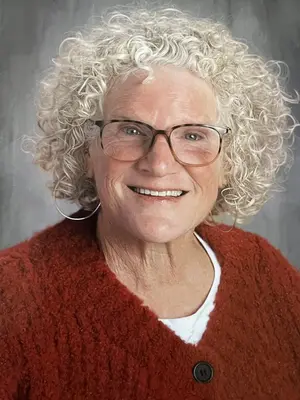
Rogers says OT also supports a person’s environment and emotional factors. She tries to concentrate on what a person can do, as opposed to what limits them.
“We focus on the positives,” she says.
When Rogers was ready for college, she couldn’t find a university in her home state that offered a degree program in her chosen field. She applied to two schools, one in Colorado and the other at the University of Puget Sound.
“I visited both schools, but Puget Sound — I fell in love with. I loved the smaller school because I struggled as a student. Instead of 100 people in my science class, I wanted 30.”
In addition, she knew that Puget Sound was regarded as one of the top schools in her field. Established in 1944, the School of Occupational Therapy was the first of its kind in the region. Today, it has more than 2,000 alumni and offers a master’s degree, a doctorate, and a post-professional doctorate. It is remains one of the top-ranked programs in the Pacific Northwest — and among the top 15% nationwide — according to U.S. News & World Report.
One constant across all the years is the caliber of the faculty. Rogers recalls that the instruction at Puget Sound was top-notch. An OT professor taught skills like woodworking and crafts, along with other activities to develop fine motor skills. But he also emphasized soft skills that have served Rogers well.
“He taught us that you are more effective when you are more personal,” she says. “If you are invested in the person, you can get so much farther.”
Rogers played tennis for a few years during college. But she spent much of her free time hanging with members of the swim team. That’s because she had her eye on a particular young man on the team.
She thought Jeff Rogers was “the cutest thing ever.” Her roommate in Regester Hall was also a swimmer, so she started attending swim meets. Jeff Rogers and Cindy Zeigler went on their first date on homecoming. By Thanksgiving, Jeff had proposed. Cindy said yes, someday. Eleven years to the day on the anniversary of their first date, they were married.
After living in Denver, they moved to Utah, where Cindy now makes her home. But their happiness was cut short in 2003, when Jeff, 39, died suddenly while biking on vacation in the Black Hills of South Dakota. He was an active person, a swimmer turned cyclist, but an autopsy determined that he died from a previously undetected artery blockage.
“He was my first love,” Rogers says. “I have never married again.”
She was left to raise her two sons, ages 7 and 4, alone.
“Thank God I had my career,” she says. “I dedicated my life to raising my kids and putting food on the table.”
That career led to her work in the school system, where she works with students who need assistance developing fine motor skills — the kind of skill that enables a child to hold a pencil — and core muscle strength that allows those skills to develop.
As OT, she worries about the long-term effects of technology, especially screens, on the development of children. When children swipe on a phone or tablet, instead of picking up a crayon or piece of chalk, she says, they don’t develop the kind of sensory perception that enables them to catch a ball, for instance. She emphasizes the need to offset screen time with time spent outdoors, exercise, and physical activities that give children the opportunity to develop their motor skills.
Overall, Rogers is grateful for her Puget Sound experience and her career.
“Occupational therapy makes you problem-solve, adapt, and move forward,” she says. “It has made me a better person. Puget Sound was a beautiful school, and a life-changing experience.”
FUTURE GRAD STUDENTS
Stories to be featured on the Future Graduate Students audience page
CURRENT GRAD STUDENTS
Stories to be featured on the Current Graduate Students audience page