The single most important piece of equipment in the world’s most popular game is less than nine inches wide and weighs just under a pound, yet its flight has brought euphoria to entire nations while plunging others into anguish. Such a crucial ingredient in soccer had better fly true. I am a physicist whose main research domain is sports, and investigating the aerodynamics of soccer balls, particularly those used in the World Cup, has been a true delight.
You likely stuck your hand out of a moving car’s window as a child. Without knowing much science, you felt air drag firsthand. With your palm facing forward, the air pushed back strongly, but when your hand tilted into “airplane mode,” the air drag lessened. The area an object presents to oncoming air affects air drag, but so do its shape and surface features. Counterintuitive though it may seem, roughening a ball’s surface may help it travel farther than it would if it were smooth. Golf balls would never soar without dimples; baseballs rely on stitches for most home runs.
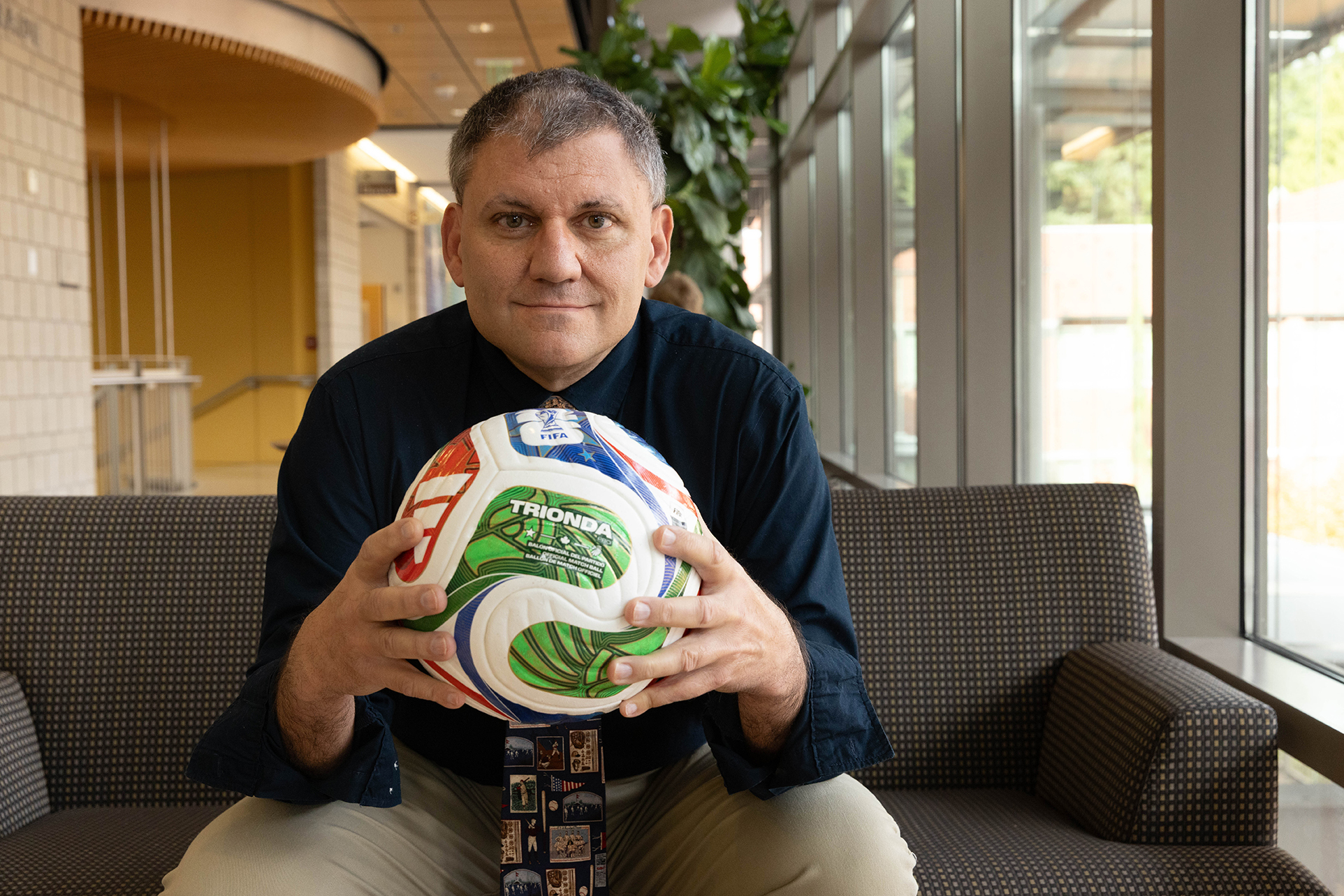
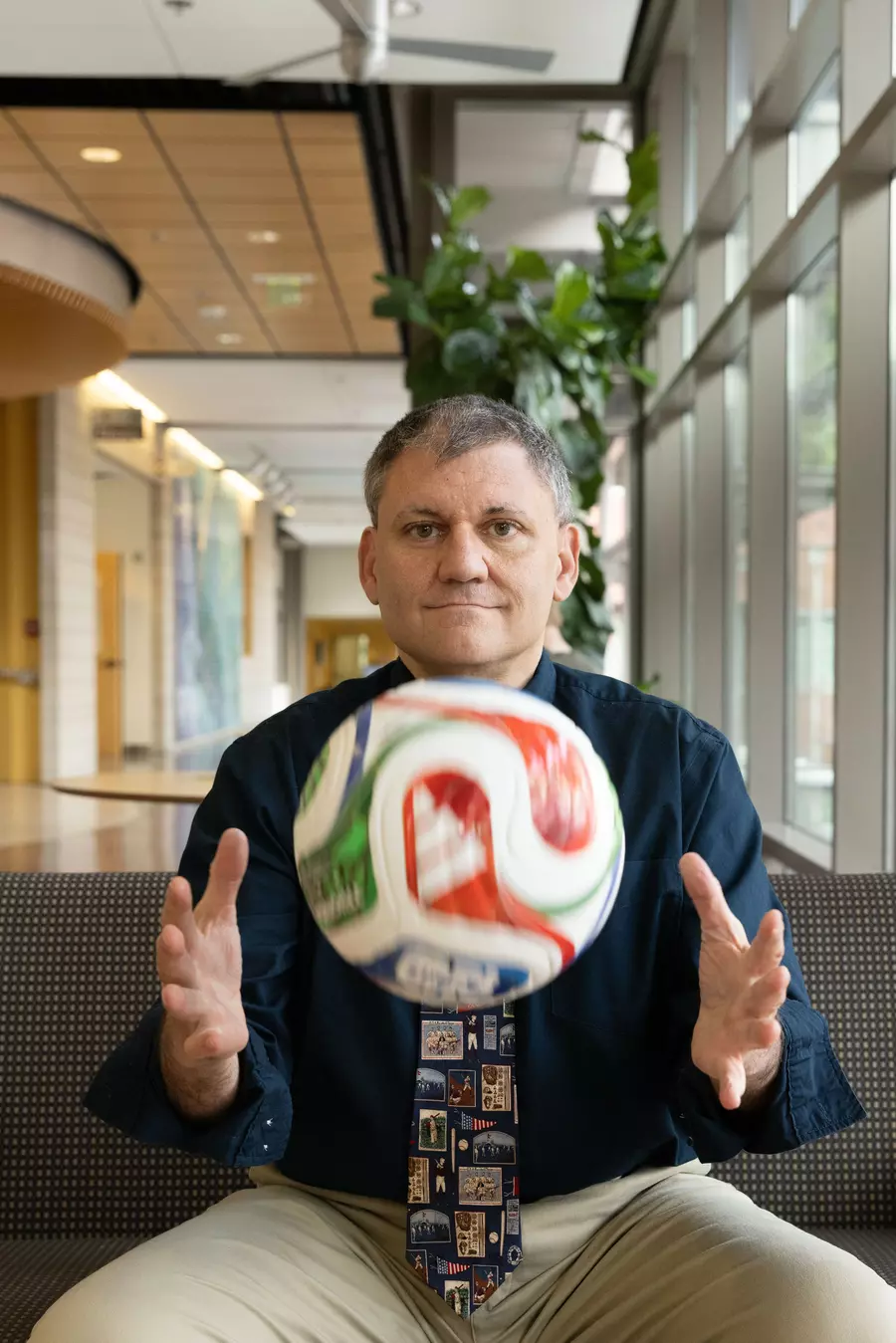
Visiting Professor of Physics John Eric Goff and his team have analyzed the aerodynamics of soccer balls used in the World Cup.
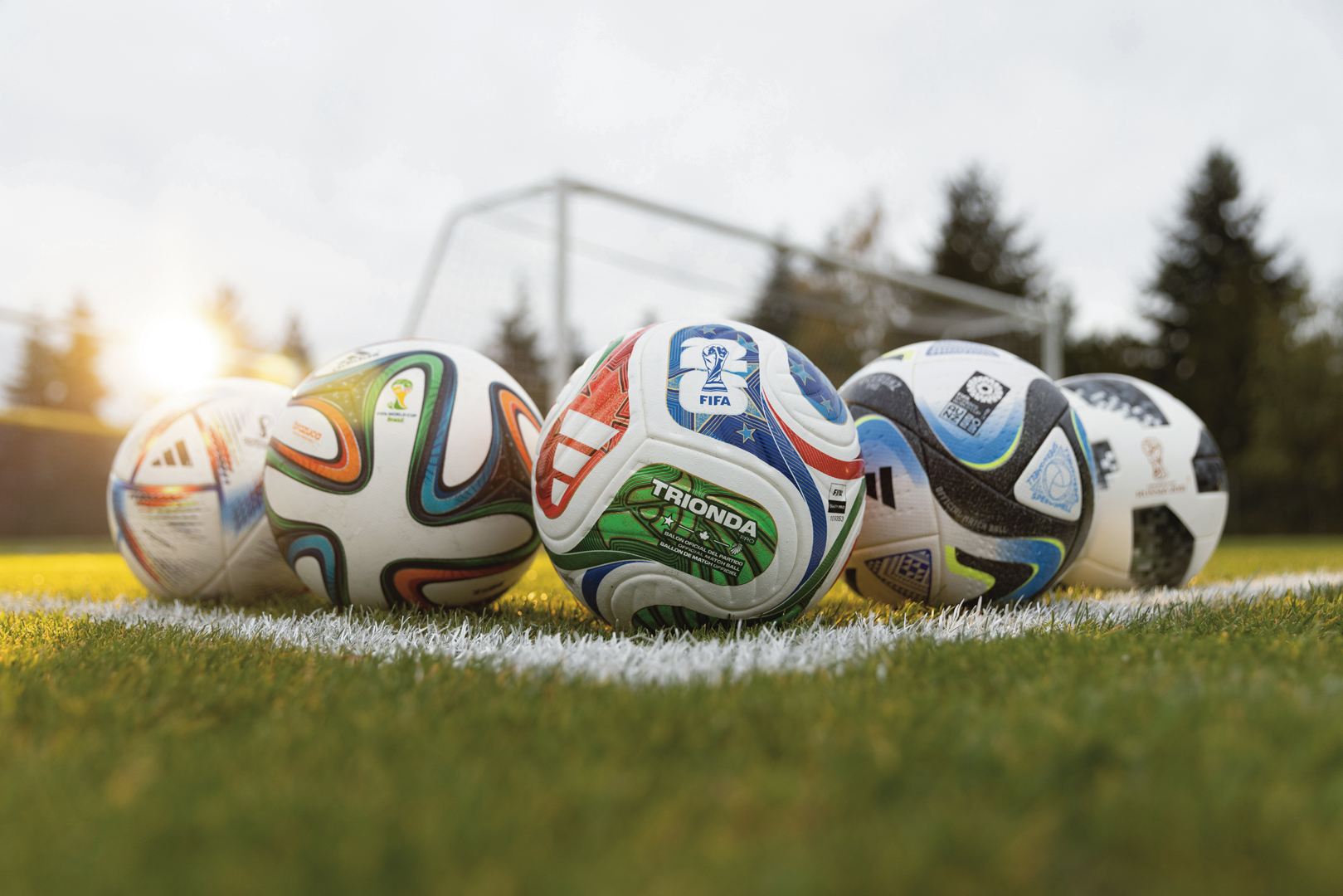
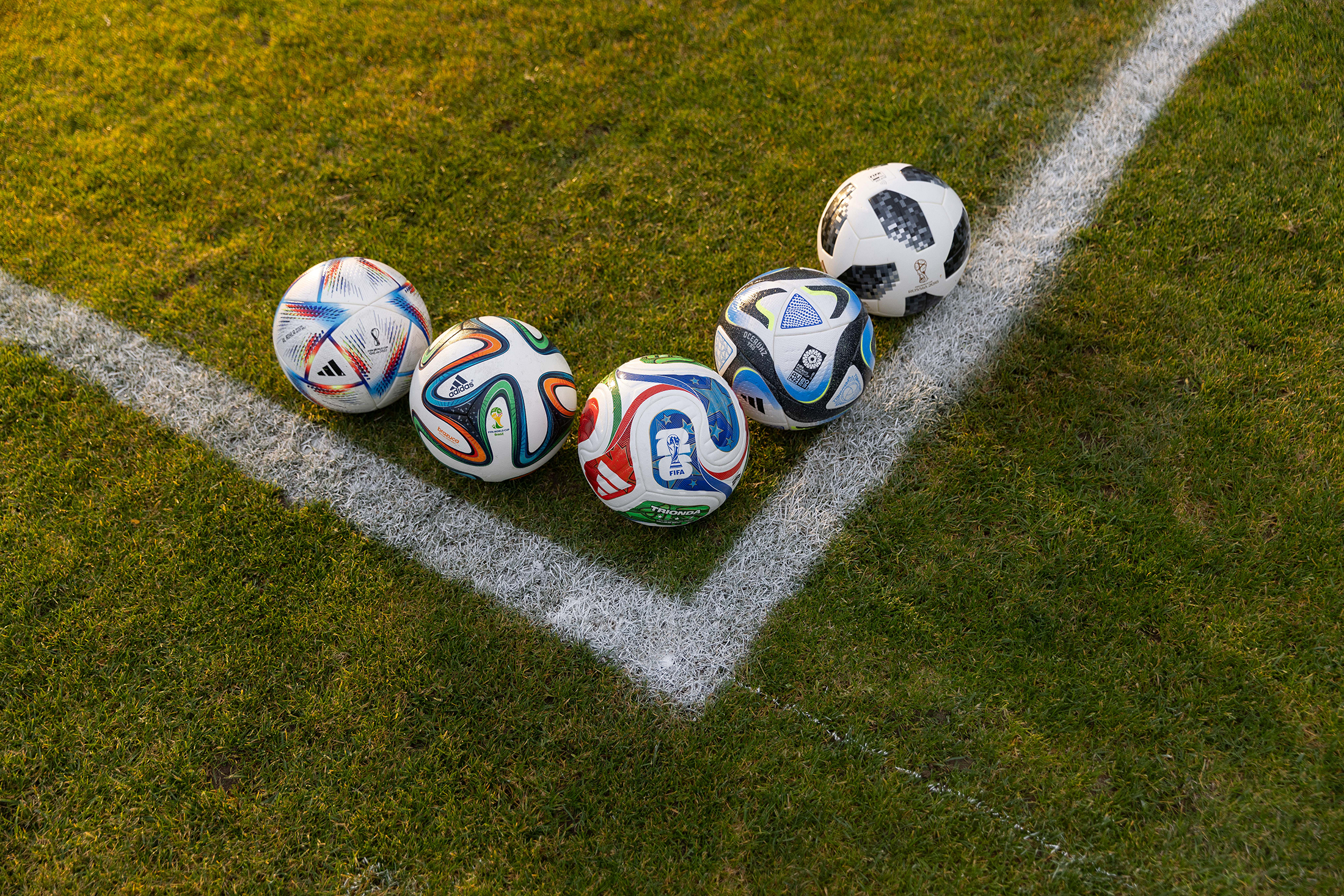
Adidas has supplied World Cup soccer balls since 1970. The ball used that year in Mexico, the Telstar, featured 12 black pentagonal panels and 20 white hexagonal panels. The iconic black-and-white pattern helped fans with black-and-white televisions track the ball’s movement. That classic 32-panel design continued until 2006, when the 14-panel Teamgeist ball was introduced for the tournament in Germany. Thermal bonding of panels replaced traditional stitching, launching a new era for soccer balls.
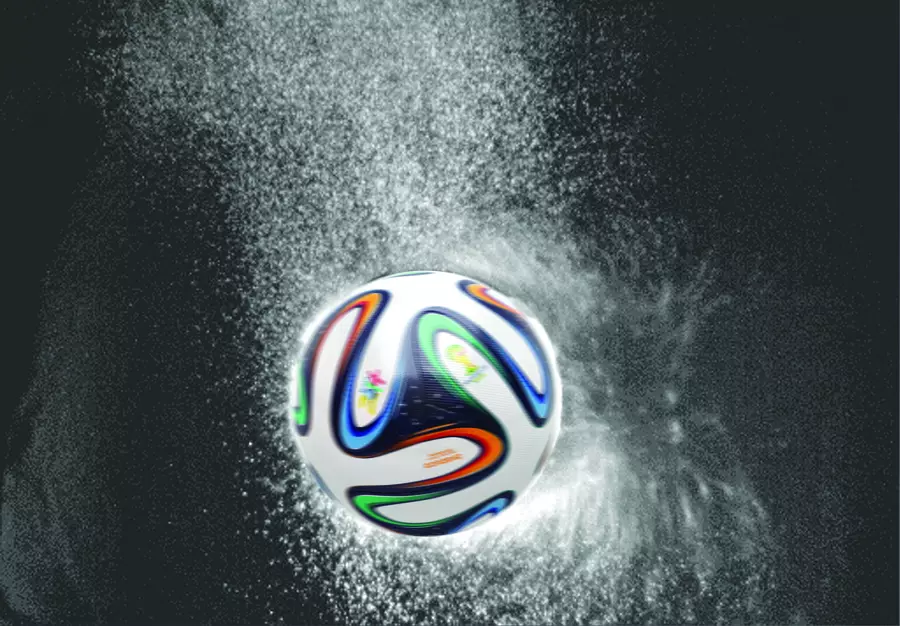
After discovering the ball used in the 2010 World Cup in South Africa, dubbed the Jabulani, was “too smooth” and seemed to slow down more than players were accustomed to seeing, the Brazuca (above) used in the 2014 World Cup in Brazil was designed with a greater total seam length and rougher panels. This restored the ball trajectories that were more familiar to players.
Further technological advancements helped produce Jabulani, an eight-panel ball used in the 2010 World Cup in South Africa. But fewer panels bring a risk: the smoother the ball, the higher the air drag. Despite some panel texturing, it turned out that Jabulani was too smooth.
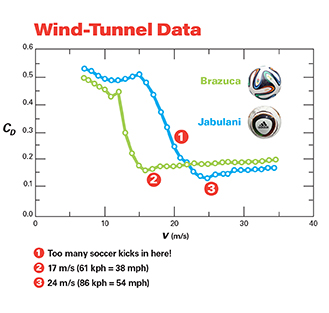
The mistake was not repeated in 2014. Brazil’s World Cup ball, the Brazuca, had just six panels, two fewer than Jabulani, but Brazuca’s total seam length was 68 percent greater, and its panels were rougher than those on Jabulani. After collecting and analysing extensive wind-tunnel data, my research colleagues and I determined that Jabulani’s drag crisis (the precipitous increase in the drag coefficient as a ball slows past a critical speed) was at too large a speed, and players, especially goalkeepers, complained long kicks seemed to slow down more than they were accustomed to seeing, much like the way a hard-hit beach ball behaves.
The graph above shows the wind-tunnel data Goff and colleagues published for the so-called drag coefficient as a function of ball speed for the Jabulani (2010) and Brazuca (2014) soccer balls.
A greater drag coefficient means greater air drag. Both balls display what is called the drag crisis, which is the precipitous increase in the drag coefficient as a ball slows past a critical speed.
By “too large a speed,” I mean that the drag crisis occurred right in the middle of the speed range where many free kicks and corner kicks take place. Brazuca’s rougher surface shifted its drag crisis to a lower speed, restoring ball trajectories more familiar to players.
My colleagues and I have also tested the six-panel Telstar-18, which was used in the 2018 World Cup in Russia, and the 20-panel Al-Rihla, which was used in the 2022 World Cup in Qatar. Both balls showed drag-coefficient curves similar to Brazuca’s. We are now eager to test the four-panel Trionda, slated for use in the 2026 World Cup in the U.S., Canada, and Mexico. That ball will be available around the time this issue of Arches is published. We will be looking to see if Trionda’s drag-coefficient curve is in the right place!
There’s a lot to love about soccer — starting with the heroic saves, the graceful footwork, and the incredible athleticism players exhibit in a game that seldom stops.
But for Maya Mendoza-Exstrom ’03, there are…
Seven Tips for Making the Most of Watching the World Cup
FIFA World Cup 2026 marks the first time in 32 years that the world’s biggest sporting event will be played on U.S. soil. Seattle will play host for the first time, with six of the tournament’s 26 matches to be played at Lumen…