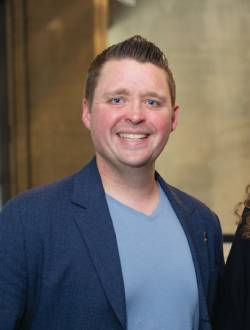
Arches, Students

Artificial intelligence was once a futuristic curiosity, but it is now woven into the rhythms of daily campus life at the University of Puget Sound — and students like Ella Tao ’27 and Minnie Jellinek ’27 have front-row seats to the shift.

Ella Tao '27

“I’m relatively comfortable in using AI in various contexts, whether it is for work, school, or personal use,” said Tao, a double major in business administration and communication studies. “However, from a broader perspective, it’s concerning to see how fast AI is evolving, especially with recent speculations about how AI could take over the world through its autonomously self-improving system.”

For Jellinek, who is majoring in religion, spirituality, and sociology, the perspective is somewhat different. “At this point I’m quite familiar with [AI] because I remember it coming into my consciousness kind of around my junior year of high school,” Jellinek said. “But honestly, I kind of struggle to see the benefits at this point just because of all the negatives that I feel about it,” including worries about the environmental effects of AI and data centers, among other concerns. Both students see distinct approaches to AI use in the classroom. Tao noted that it is mostly beneficial to let professors choose their own policies or collaborate with students to generate them, encouraging critical thinking. Jellinek shared a mutual understanding between professors and students. “I had a professor tell us that this might be the last time in your life that you can submit thoughtful work and someone will evaluate it deeply and give it back to you, so make use of that,” she said.

Minnie Jellinek '27

A campus survey conducted by Puget Sound’s AI working group in 2026 found that nearly 45 percent of faculty, staff, and students are already using AI in their daily work and studies. Among students, the majority report using it for feedback on their work, suggesting research ideas, and outlining writing assignments. Faculty members report primarily using AI for administrative tasks, research, and preparing class materials, with 52 percent allowing its use in their courses with some restrictions.

This isn’t just a story about technology adoption, though. It’s also a story about what comes next, which is one of the things to love about Puget Sound — the university’s commitment to meeting change with curiosity rather than fear. In the following pages, you’ll meet some of the folks leading the charge. You will hear from a professor teaching students how to weigh AI’s ethical implications, a young lawyer grappling with the unexpected demands of an AI-augmented practice, a tech leader rethinking how organizations can truly innovate, and a chief information officer helping to build the framework for responsible, secure usage on campus. Together, they demonstrate why a liberal arts education — rooted in critical thinking and deep ethical inquiry — is the most essential tool for navigating a future defined by AI.


Teaching AI and Human Values 
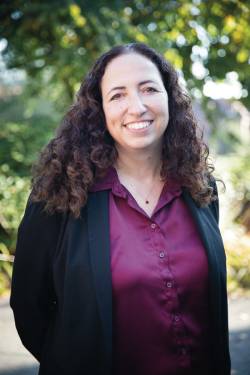
Prof. Ariela Tubert, Philosophy

As the director for Puget Sound’s newly created interdisciplinary emphasis on AI and Human Values, Professor of Philosophy Ariela Tubert teaches students entering a workforce where AI is reshaping job descriptions and ethical boundaries. In her Ethics, Data, and AI class, she takes a values-based approach that examines how AI can further human values like privacy and creativity, and where it may present risks. “We look at different sets of values and think about whether AI can help us further those values or does it undermine them,” Tubert said. “So we ask, ‘when is AI useful and when is it not?’”

Tubert advises recent graduates not to let AI hype replace foundational skill-building. “Instead of using AI to simply go through the motions when you start a new job, focus on understanding why things are done the way they are because that depth of understanding is going to be needed as processes change,” she said.

For alumni who have been in the workforce for decades and are now being told to integrate AI into their roles, Tubert’s advice is both practical and philosophical: Know your work deeply enough to advocate for where AI belongs — and where it doesn’t. “People who have been on a job for a long time have an understanding of the work they do that maybe other people don’t have,” she said. “It’s important for them to convey to others what parts of the job they think it’s a bad idea to pass on to AI because these are tasks where human skill may still needed to be in charge.”

She points to a liberal arts education as uniquely suited for this moment. “Our emphasis on critical thinking and ethical values helps students prepare for a future that is going to be changing,” Tubert said. “What will work look like in four or five years? We don’t know exactly. But we do know that people will need to know both how to interact with AI and what not to pass on to it.”


Illustration of a gear with a hand turning a key

AI in the Workplace: More Efficiency, More Work

Benjamin Sovocool '21

When Benjamin Sovocool ’21 began using AI in his legal practice, he expected efficiency gains. What he didn’t expect was a heavier workload. “I use AI constantly, but I have not become any less busy — if anything, I am busier than ever,” said Sovocool, a lawyer based in New York. “There is so much work that previously was too time-consuming and expensive to really get done. The demand for legal services is nowhere close to being fulfilled.” 

Sovocool graduated with a double major in economics and philosophy before earning his law degree at Cornell Law School. When he thinks about how AI has influenced his professional life, he shares a recent project where AI transformed work that used to require weeks of manual document review.

His client, a pharmaceutical company, wanted to know what market trends and standard terms looked like in public merger agreements. Historically, that meant reading through multi-page documents, extracting relevant clauses, and compiling spreadsheets. Now, thanks to AI, he can pull filed agreements and extract relevant language in hours.

“Obviously, you still have to review it to ensure accuracy as it isn’t always 100 percentcorrect,” he said. “But when you can do it that much faster, clients don’t just say, ‘I’m glad we did that quickly.’ They say, ‘Since you did that so easily, can you look at this data too?’ There is an endless list of additional work.”

Ben Sovocool '21
ALUMNUS
Ben Sovocool '21

Puget Sound’s mission to provide a space where students can develop that deep expertise is so vital to today’s workforce.

Sovocool credits his liberal arts education — particularly philosophy courses — with preparing him for this new way of working. “The value of having surface-level knowledge of an issue is now basically zero,” he said. “Real expertise is the new currency. Research by Anthropic shows that the quality of AI results relies primarily on how well the user understands the topic, rather than just the AI tool itself.” This is why Puget Sound’s mission to provide a space where students can develop that deep expertise is so vital to today’s workforce. His advice for new graduates navigating AI in any field is to really consider what they want to be doing in the future. “Take a beat to think more critically about what you want and what you want to achieve,” he said. “Simply doing tasks faster is not necessarily conducive to human flourishing — we have to direct our actions toward good ends.”


Professional Advice on Rethinking AI in the Workplace

Ryan Cunningham '05

In his role leading the product and engineering teams behind Microsoft’s AI business tools, Ryan Cunningham ’05 has had a front-row seat as companies across every industry attempt to integrate artificial intelligence into their operations. Through these conversations, he has observed a consistent pattern among those who struggle to see results. He said they prioritize the technology itself over the specific problems they are trying to solve. 

Cunningham serves as corporate vice president for Copilot Studio and Power Platform at Microsoft. That vantage point puts him in regular conversation with leaders across industries, and he said the pattern is consistent. Companies feel pressure to be seen “doing something with AI” and end up bolting a chatbot onto an existing process rather than asking what a genuinely better version of that process would look like. 

Sometimes, reaching goals means rethinking processes from the ground up. Cunningham said to see real benefits, organizations must be willing to completely rethink and shred their core operating methods to change how they function day to day. This willingness to look past legacy habits is exactly why he sees an unexpected advantage for newcomers entering the workforce. “As much as it is a disadvantage to not have 15 or 30 years of experience in a field, it is also a huge advantage to not be bound by the understanding of how it was always done before,” he said.

For alumni deeper into their careers, some of whom are anxious about the pace of change, Cunningham’s message is more optimistic than cautionary. He argues AI is shifting leverage away from software engineers alone and toward people who deeply understand their own field — finance, education, nonprofit work, journalism — because it’s now far easier to put powerful tools directly into the hands of people who already know what better looks like in their world. It’s a
perspective shaped by his own background as an international political economy major. 

Cunningham said the underlying dynamic is familiar compared to previous technological shifts he has experienced, such as the early internet, cloud computing, and the rise of social media, even if this shift is faster and more capital-intensive than the previous ones. “Every platform shift creates winners and losers,” he said, “and the people who navigate it best tend to be the ones who stay curious and get in early, rather than waiting for the rules to be fully written.”

Illustration of a glowing gear

How Puget Sound is Navigating AI on Campus

Walk across campus on any given day, and chances are nearly half the people you pass have recently used artificial intelligence — whether they will admit it or not. 

The data from a 2025 campus survey by the university’s AI working group is an important starting point. The survey, which received 521 responses, helped shape the group’s policy recommendations and strategic priorities. What it could not settle was the more nuanced question of how to tell when a given use of AI actually served the university’s mission, and when it didn’t. 

Prof. Gareth Barkin

This challenge has been at the forefront of efforts co-led by Associate Provost and Professor of Anthropology Gareth Barkin and former university chief information officer Francisco Chavez. The group collaborated to create an ethical framework inspired by the university’s Institutional Review Board process — the same rigorous method used to evaluate research and projects involving human subjects at Puget Sound. This framework now guides decisions about when and whether to adopt generative AI tools on campus.

The working group’s other outcomes include a resource site for students, staff, and faculty as well as recommendations for supporting the development of critical AI literacy across campus. But the heart of the effort is a set of seven ethical principles that ground every decision in the university’s mission, rather than in the technology itself. Barkin frames the university’s goal as greater understanding, not AI adoption. “We want people asking where and whether these tools genuinely serve our goals as an institution of higher learning,” he said, “and we must demonstrate a willingness to set them aside where they don’t.” 

Prof. Gareth Barkin
Associate Provost and Professor of Anthropology
Gareth Barkin

We want people asking where and whether these tools genuinely serve our goals as an institution of higher learning.

Barkin sees the university’s liberal arts ethos positioning Puget Sound to manage AI intentionally. Small class sizes and close relationships between faculty and students make room for critical thinking to be taught alongside disciplinary knowledge. “Our size lets us do this work relationally, through thoughtful conversations between faculty and students,” he said. “That’s how our students graduate with the contextual awareness and creative instincts that are indispensable in an AI-saturated world.”

Barkin returns to the same principles to answer a common question from alumni: how to keep AI from reinforcing bias in their own organizations. “These systems learn from historical data, and that data carries the inequities we’re still working to address,” he said. “On its own, AI tends to reproduce those patterns. Grounding decisions in mission-based principles allows us to push back against them.”