
Brown & Haley Lecture Series: "The Gentrification of Transition into Art and Theory, 1980-1990s" with Jules Gill-Peterson
Originating in 1953, the Brown & Haley Lecture Series became the first fully endowed lectureship in the history of Puget Sound in 1981. The lectures are intended to make significant contributions to the understanding of urgent problems confronting society, emphasizing perspectives in the social sciences or humanities. In recent years, the Brown & Haley Lecture Series has invited an emerging scholar to offer two lectures speaking to two or more fields during their two-day residency.
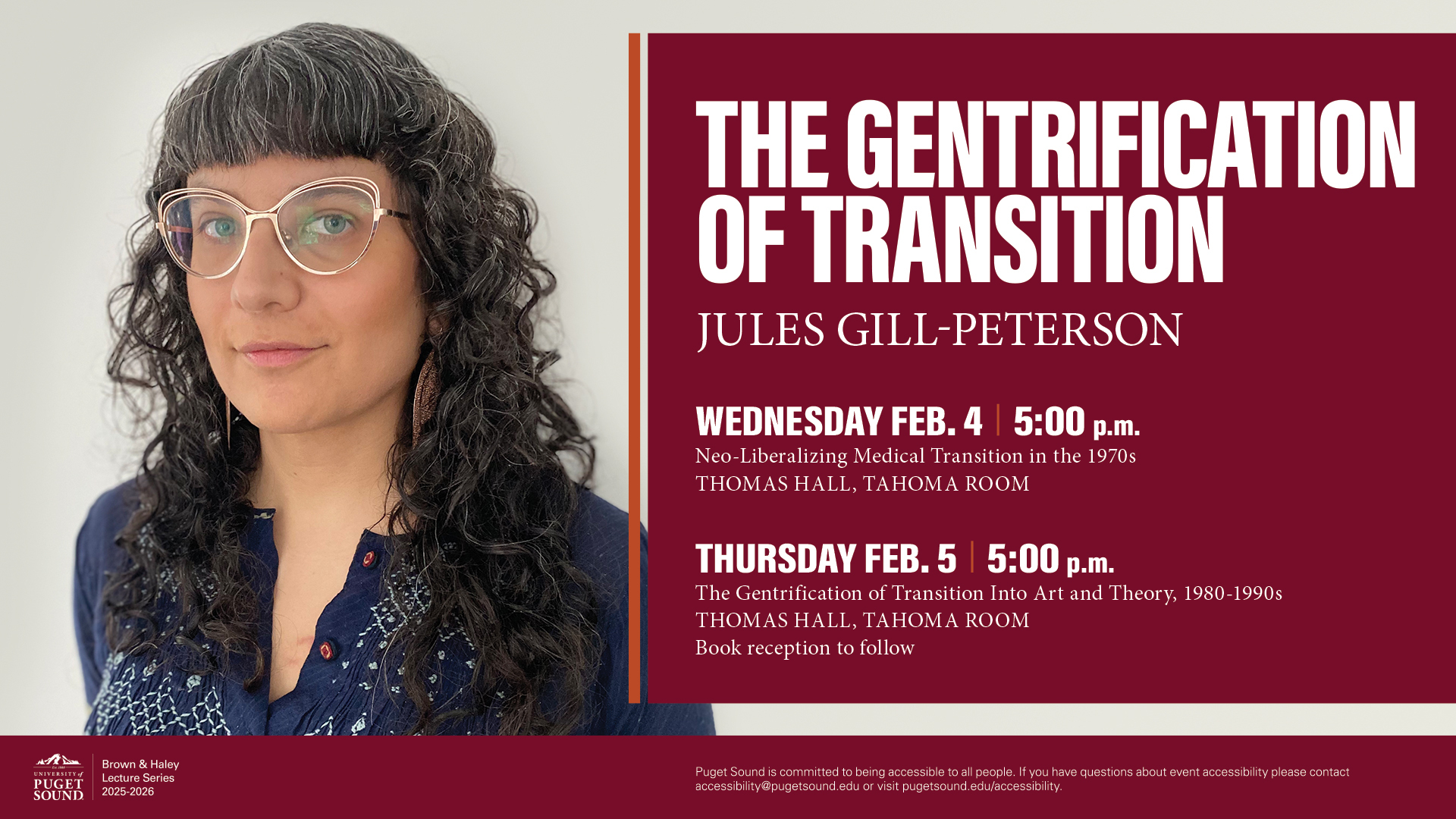
This year, we have two lectures on The Gentrification of Transition presented by historian Jules Gill-Peterson on February 4 and 5, 2026, in the Tahoma Room.
Jules Gill-Peterson is a US-based writer, activist, and the author of the award-winning book Histories of the Transgender Child (2018). Gill-Peterson is a tenured associate professor of History at Johns Hopkins University and a General Editor of TSQ: Transgender Studies Quarterly, the journal of record in the field. She has earned a public reputation for fiercely advocating for transgender children and women, with interviews in outlets from NPR, to ABC, to New York magazine. She was profiled by the Guardian and published an op-ed on trans kids in the New York Times in 2021. She has also written for the New Inquiry, Jewish Currents, the Baffler, the Funambulist, Parapraxis, and more. Gill-Peterson is the cohost of Outward, Slate's LGBT podcast, and a member of the Death Panel podcast. She is also the narrator of the award-winning documentary Framing Agnes (dir. Chase Joynt, 2022), which premiered at the Sundance Film Festival. Her most recent book is A History of Trans Misogyny (2024).
Lecture 1 - "Neo-liberalizing Medical Transition in the 1970s"
Wednesday, February 4 at 5 - 6:30 p.m., Tahoma Room, Thomas Hall
How did transgender medicine as we know it today come to be? And why is it so difficult to medically transition? This lecture explains the economic basis of the gender dysphoria diagnosis created at Stanford University’s gender clinic in the 1970s. As the model adopted worldwide, gender dysphoria syndrome led to the deregulation of transgender medicine. For the past fifty years, patients have been forced to shoulder the entire cost of changing sex on the private market, turning money into the ultimate arbiter of who gets to transition.
Lecture 2 - "The Gentrification of Transition into Art and Theory, 1980-1990s"
Thursday, February 5 at 5 - 6:30 p.m., Tahoma Room, Thomas Hall
How did transgender become associated not with physically changing the body, but language, style, and personal identity? And why do right wing populists charge transgender politics with being elitist? This lecture digs into the process through which transition was gentrified into high art and theory during the 1980s and 1990s. Artists, academics, and college-educated people turned transgender into something cool for themselves during these decades by rejecting medical transition, while also depending on transsexual techniques to enhance their personal image.
Book Reception after the lecture: Feb. 5 at 6:30 - 7 p.m., Tahoma Room, Thomas Hall.
Thomas Hall, Tahoma Room