
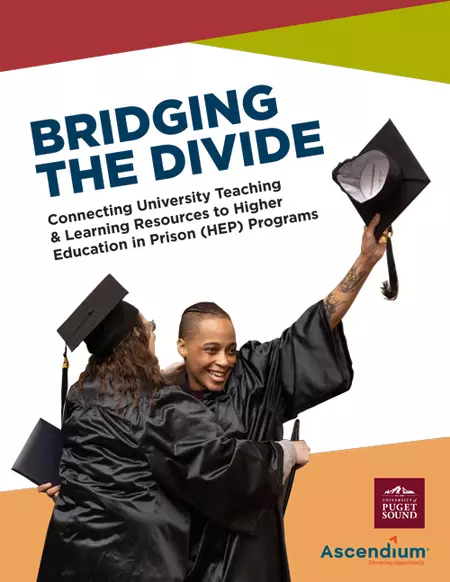
Bridging the Divide
RESEARCH TEAM
Tanya Erzen, Ph.D. |
Carrah Goble | Lauren Moseman | L. Elizabeth Shatswell
Full Report (PDF)

Thousands of people in prison are enrolled in college classes in more than 370 higher education in prison programs (HEPs). However, there are numerous obstacles to students in prison receiving an education equivalent to campus students. Some of that includes the prison learning environment itself. However, much also includes a disconnection from campus resources.
Teaching and learning centers—encompassing writing centers, academic support services, tutoring programs, and faculty development hubs—are home to experienced staff committed to inclusive pedagogy, student success, and continuous faculty learning. Yet many of these educational developers are unaware of their university’s own HEP program and the students who could benefit tremendously from their support.
Inside Bridging the Divide, you will find:
- A landscape scan of HEP programs, the challenges of the prison learning environment, and the benefits of getting an education in prison.
- Analysis and case studies of the barriers and promising practices of integrating university teaching and learning resources with their HEP programs.
- A call to action for universities to recognize incarcerated students as full members of the campus community.
Based on in-depth interviews with HEP program faculty, teaching and learning center staff, a national survey of HEP alumni and current students, and a focus group of HEP students, Bridging the Divide reveals that when teaching and learning centers collaborate directly with HEP programs, the results are transformative—for students, faculty, and universities alike.

–HEP program director and faculty
“I dream that someday universities will fully recognize that our incarcerated students ARE university students and should have access to the wide array of resources that universities offer.”
Resources from the Report
All resources we gathered are available on the Resource Community for Higher Education in Prison (RCHEP) under Teaching, Learning and Pedagogy
-
Writing center handbook, syllabi, and trainings for building and sustaining learning and tutoring centers inside prison with alumni and current students
-
Pedagogy handbook and training with interactive activities for adapting content/assignments/assessments to the prison context, teaching low-tech, and utilizing universal design to address student disabilities and learning challenges