
Learn About the Applied Practice Experience (APE)

A keystone of the Master Public Health curriculum, the Applied Practice Experience (APE) provides students with the opportunity to transition from theory to an informed practice of public health. It is also central to our program’s mission to prepare a public health workforce of culturally responsive graduates who promote health equity and community wellbeing. During the APE our students partner with community organizations to apply public health skills they’ve learned in the classroom to real-world settings. Working closely with their site preceptors and our practicum coordinator, Dr. Alexandria Drake, students complete two distinct practice based deliverables tailored to the organization’s needs and student’s interest.

The APE takes place in the summer between the first and second year curriculum, giving students the opportunity to put their learning into practice before completing their degree. Students may complete their APE at a location of their choosing, allowing them to explore areas of interest and begin shaping their professional career. Through these hands-on experiences students tailor their generalist MPH education to meet their individual professional goals, while making meaningful contributions to the communities they serve. We’re always excited to share what our students have been working on - below are some APE stories from our graduating class of 2026!
 

Student Stories

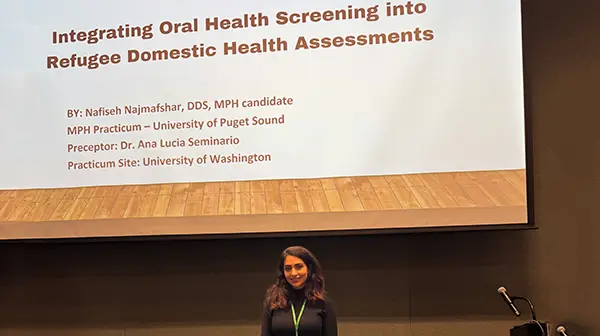
Nafiseh Najmafshar presenting
Nafiseh Najmafshar

Nafiseh completed her practicum at the University of Washington with Dr. Ana Lucia Seminario as her preceptor. Through her summer practicum, Nafiseh was able to combine her growing public health skills with her clinical background in dentistry. Nafiseh’s increasing awareness of structural gaps excluding oral health from broader public health systems, particularly in refugee and underserved populations, helped to define her deliverables. These deliverables aligned with her interests in health policy and equity and “gave me a meaningful platform to address that gap through policy-focused work.” This deepened her understanding of how social factors, systemic barriers, and federal policy can influence health outcomes.

Nafiseh evaluated the feasibility of integrating an oral health screening into the CDC’s Domestic Medical Examination (DME) guidelines for newly arrived refugees. With this as an overarching goal of her practicum, Nafiseh was able to further understand the oral health needs of vulnerable populations, improve her skills in research, data analysis, policy evaluation, and communication with both technical and general audiences.

For her deliverables, Nafiseh conducted a literature review and comparative state policy analysis as well as creating a policy flowchart and infographic. This allowed her to conduct a needs assessment and highlight the lack of oral health requirements and standardized protocols in the DME and state practices. Her policy flowchart and infographic simplified complex policy processes into clear visuals to communicate public health content to various audiences such as policymakers, health advocates, and community organizations. “The most valuable part of my APE experience has been learning how to translate a public health concern into a structured proposal and advocacy effort…It has helped me move beyond identifying disparities to actively working toward systemic solutions.”

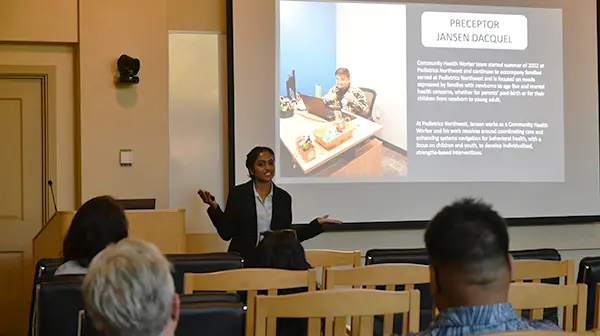
Pratibha Thomas presenting
Pratibha Thomas

Pratibha completed her APE experience at Pediatrics Northwest with community health worker (CHW) Jansen, a Puget Sound alum from the MPH program, as her preceptor. Working with Jansen and Rachel Letteri, the Director of Care Transformation, Pratibha was able to identify projects or deliverables both meaningful to her own interests and learning and useful for the organization. Through her practicum, Pratibha was able to use what she learned in the Program Planning and Evaluation course in a real-world setting. For Pratibha, Peds NW was the perfect practicum site, their focus on intersectoral collaboration and community health aligned with her interests and guided the creation of her deliverables.

Pratibha developed a resource map and designed a health promotion toolkit for community health workers to use - contributing to initiatives directly supporting community health programs. “I didn’t want it to be just another static map. It had to be something that could inspire action, like building partnerships with those service providers or finding ways to bring resources into ‘resource deserts.’ This project really made me see how not having access to basic needs can have such a huge ripple effect on health and well-being.” She was able to create a toolkit for the public health team - breaking the cycle of program planning, implementation and evaluation into easy to digest modules and ready-to-use templates, simple enough for someone without a public health background to follow. “It wasn’t just about creating deliverables - it was about building something that could keep working long after my practicum ended. And for me, that’s what makes this experience so meaningful.”

Additionally, she conducted a professional reflection log. Shadowing staff in various departments of the organization, and reflecting on this allowed her to see the contributions of each position on improving patients’ lives and recognize how they are linked through intersectoral collaboration.

“This experience also helped me grow in ways I didn’t fully expect. Creating the resource map taught me to look at communities as a whole and not just focus on what’s broken, but also on what’s already working and how to build on it. The toolkit pushed me to think about how to take complex processes and make them simple and practical. And shadowing different staff reminded me that population health isn’t just about policies and programs, but it’s about people, relationships, and meeting needs where they are.”

Frequently Asked Questions
Meet MPH Faculty
Meet MPH Students