Office of Student Accessibility & Accommodations

Howarth 103

1500 N. Warner St. #1096
Tacoma, WA 98416-1096

253.879.3399
253.879.3786
Monday - Friday
8:30 a.m. - 4:30 p.m.

Accommodation & Testing Supervisor

Joey Decker

Access Specialist

Caroline Menzia

Accessibility in Higher Education

Transition from High School to College

Disability:

  • Any condition that substantially limits one or more major life activities such as but not limited to:
    • Walking
    • Seeing
    • Hearing
    • Speaking
    • Breathing
    • Learning
  • Common types of disabilities may include but are not limited to:
    • Mental health conditions
    • Chronic health conditions
    • Learning disabilities
    • ADHD
    • Autism
    • Sensory conditions
    • Physical conditions

Accommodations:

  • Adjustments or modifications that allow people with disabilities to participate in activities like school or work. 

Accommodate:

  • An online platform that is used by students, faculty, and SAA staff to request, track, and store the details of a student's accommodations and test room bookings.


College Readiness for Students with Disabilities

Disability support works differently in college than it does in K–12, and understanding those differences ahead of time makes the transition easier. This page is written for families and high school staff helping a student prepare for college. It is general information rather than legal advice — policies vary by institution, so check with the disability office at whichever school a student plans to attend.

Section 504 protections follow students into higher education, but an IEP or 504 plan does not carry over automatically.

What changes after high school
  • Colleges do not provide special education services.
  • Accommodations remove barriers; they do not change what a course requires. Modified exam content, shortened assignments, and automatic retakes fall outside what colleges typically approve.
  •   Grades reflect mastery of the material rather than effort or time spent.
  • There is no para-educator support or disability-specific supplemental instruction.
Support beyond accommodations

Accommodations are one piece of a much larger set of resources. Tutoring, academic coaching, and faculty office hours are open to every student and are often exactly what helps.

The role of families

College students are legally adults, and services are provided directly to them. That shift is real, and it is one of the biggest adjustments families describe.

  • Students drive the process. We can help a student build self-advocacy skills, but they schedule their own appointments, answer their own emails, and talk with staff and faculty about what they need.
  • A signed release lets us share information with a parent or guardian. It does not allow anyone to act on the student's behalf.
  • Logging in to a student's account or learning management system on their behalf may run afoul of privacy law. Helping a student build their own system for tracking coursework tends to work better anyway.
The process

Every college has a person or office responsible for determining reasonable accommodations. Names vary — Disability Services, Access Resources, and similar. At Puget Sound, it is Student Accessibility and Accommodation (SAA).

  1. The student submits a request to begin the process.
  2. Most schools ask for information from a health care or other qualified provider. What counts as adequate documentation differs from school to school.  
  3. The student meets with a staff member to talk through how their disability affects them in class or in housing, and what accommodations would help.
  4. Once accommodations are approved, the student works with staff to notify their faculty each term.
  5. If something is not working, the student raises it with the office. We consult with students and faculty as questions come up.
Skills for college success

These are skills students keep developing throughout college — nobody arrives with all of them.

  • Naming their disability and describing how it affects them
  • Recognizing their own strengths and challenges as a learner
  • Asking for help when they need it
  • Managing their own schedule — getting to class, starting assignments, studying without prompting
  • Coping strategies for stress and anxiety
  • Taking usable notes, or using technology to capture lecture material
  • A system for keeping track of assignments and appointments

All students, including students with disabilities, are held to the same college policies — the student conduct code and academic progress requirements included.

Accommodations create access. They do not guarantee success, and they are not meant to. Students with disabilities have the same right as anyone else to take risks, and to grow from how those risks turn out.

Questions?

Contact Student Accessibility and Accommodation at saa@pugetsound.edu or 253.879.3399.

Adapted with thanks from a resource developed by the Washington Association on Postsecondary Education and Disability (WAPED).

There are fundamental differences between services for students with disabilities in K12 and accommodations appropriate to the higher education environment. The following information is intended to provide students and families with a general understanding of the way accommodations are provided in higher education.  

  • Although Section 504 protections apply to students in both K12 and higher education, accommodations from a high school 504/IEP do not necessarily transfer to college. Special education services are not provided in the post-secondary system.
    • Changing exam content, shorting assignments, and allowing test retakes lessens the academic rigor and are not accommodations typically provided in higher education.
    • Grades are based on the mastery of course content, not seat time or effort.
    • There is no supplemental instruction or para-education specifically for students with disabilities in higher education.

In higher education, students are considered to be adult learners. Colleges provide services to students. The interactive process for obtaining accommodations is student led. A parents' role in this process is one of support for their student in becoming strong self advocates. This could include teaching students how to engage in the process, acting as a check point for students monitoring their progress through the process and/or assisting students in identifying/obtaining necessary documentation. Parents should not attempt to initiate the process for receiving accommodations on their students behalf. Students are required to actively participate in the process. Our accommodations are trained and highly experienced in working with students with disabilities and will do all they can to ensure the student feels supported and heard throughout the process.

Accommodations in higher education are designed to provide equitable access for students with disabilities but do not guarantee success.  

Documentation

To determine eligibility for disability-related accommodations, the Office of Student Accessibility and Accommodation (SAA) requires documentation that demonstrates how the diagnosis rises to the level of a disability that substantially limits one or more major life activities. Documentation should clearly articulate the student’s functional limitations within the University’s academic, housing, and broader campus environment.

Documentation requirements may vary across institutions and formal testing bodies. If you plan to seek accommodations on standardized tests (such as graduate school entrance exams or licensure exams), you should review the documentation policies of those testing agencies separately. The documentation guidelines outlined here apply only to the University of Puget Sound’s internal accommodation process.

SAA engages in a collaborative process that is responsive to the needs of each individual as advised by the Americans with Disabilities Amendments Act of 2008 (ADAAA).  Third-party documentation assists SAA in understanding whether a student has a diagnosis that rises to the level of a disability, how that disability may impact a student in the academic, housing, or other campus related environment, and in making informed decisions about reasonable accommodations.

Please note that you can meet with an SAA Accommodation Specialist before submitting documentation. Accommodation Specialists can discuss any documentation needs during your Welcome Meeting. 

Examples of different types of Disability-related Documentation that may contain relevant information:

  • Neuropsychological or educational evaluation
  • Educational records, such as a high school accommodation plan (IEP, 504 plan, etc.)
  • Medical Records, including vision assessment, audiology report, etc. 
  • A letter from an appropriate healthcare professional, on letterhead, which confirms a diagnosis/impact of the disability
  • SAA has created a Documentation of Disability Form for your provider to complete. This form is designed to guide the provider in submitting necessary elements needed to make an eligibility determination.

This is not an exhaustive list and SAA may request additional documentation to understand the disability's impact, the described obstacle, and the requested accommodation. If questions arise, SAA will work with students to determine next steps in obtaining necessary documentation.

Material has been adopted from the Association on Higher Education and Disability (AHEAD).

SAA’s goal is to provide access without creating obstacles. If you experience any trouble during this process, please reach out to SAA (saa@pugetsound.edu) for support.

Accessibility at Puget Sound

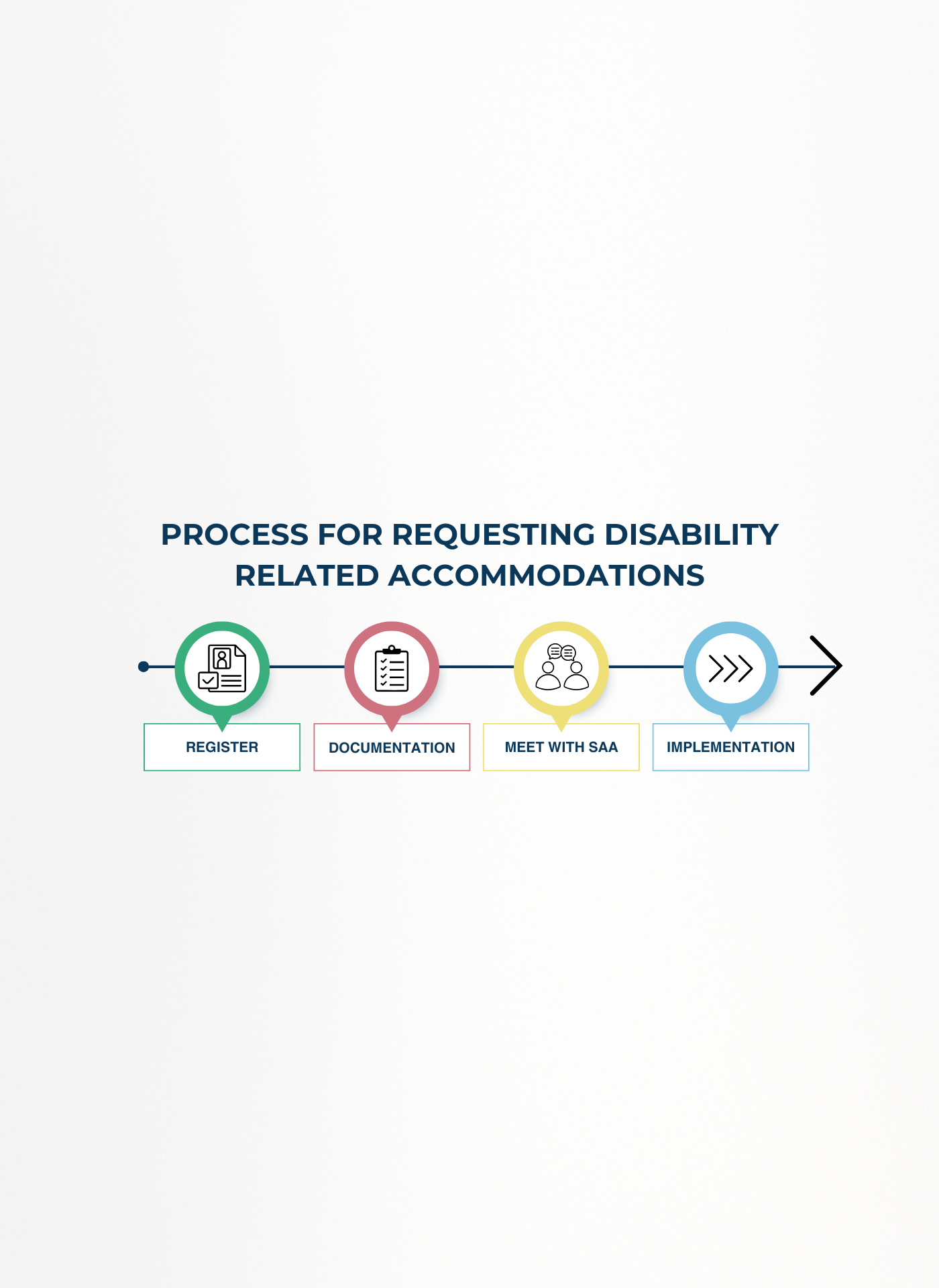
Process for Requesting Disability Related Accommodations. First, register. Second, Documentation. Third, Meet with SAA. Fourth, Implementation.
  1. Register

    -Register for Disability Accommodations via a Request for Accommodations Form.

  2. Documentation

    -Submit any documentation you have such as a Documentation of Disability Form, 504 Plan, IEP and Medical Documents.

  3. Meet with SAA

    -You will attend an Initial Meeting with an Accommodation Specialist to discuss potential accommodations. After your initial meeting and receipt of necessary documentation, students will be scheduled to attend a “How To” (access and use your accommodations) Meeting.

  4. Implementation

    -This process generally takes two weeks from initial request to implementation of accommodations.

Disability-Related Accommodations